Open source powers most modern software and expands your attack surface. At APIdays London, Meterian CTO Bruno Bossola showed how a crafted JSON request can trigger remote code execution when a vulnerable dependency slips into a service.
The key takeaway was that without visibility and fast remediation, vulnerabilities ride your software supply chain into production.
1) Exploits start upstream, not in production
Meterian’s live demo used a known jackson-databind flaw to execute code via a JSON payload. Incidents like the Apache Struts 2 breaches proved the same point years ago: attackers go where libraries are ubiquitous and exposure is public-facing.
Teams still discover many issues late, inside CI/CD or after release. By then, the vulnerable package is woven into multiple services and rollbacks get expensive.
What to change
Shift security into the IDE so developers see and fix dependency risk as they code.
Add pre-push and CI checks to block known-bad versions before they land on main.
2) You can’t patch what you can’t see
Most applications are a small slice of proprietary code on top of a large stack of third-party packages. New CVEs appear daily across NVD, OSV, and GitHub Advisories. If you don’t know exactly which versions you run—including transitives—you can’t assess blast radius or prioritise patches.
What good visibility looks like
Keep an up-to-date SBOM for every build (e.g., CycloneDX) and ingest vendor SBOMs.
Continuously monitor your dependency graph against live feeds and internal policy.
Prioritise RCEs and internet-exposed paths first, then reduce debt in lower-risk services.
3) Make remediation fast and routine
In the demo, upgrading a vulnerable component inside the IDE removed the exploit path in seconds. That’s the experience to aim for: actionable guidance at the moment of discovery, with one-click upgrades where possible. Speed reduces MTTR, avoids regressions, and prevents risk from spreading across repos.
Operationalise speed
Standardise one-click upgrades and automated PRs for safe versions.
Set patch SLAs by severity and exposure (e.g., 24–72 hours for critical RCEs).
Track MTTR, exception waivers, and policy drift to guide platform investments.
A simple workflow that works
IDE (shift left): real-time vulnerability assessment of manifests and transitive dependencies, with suggested fixes developers can apply immediately.
Pre-push: Git proxy hooks to enforce policy and block known-bad versions.
CI/CD: SCA checks per build, SBOM generation/signing, and fail-the-build on criticals.
Post-build: continuous monitoring of deployed SBOMs against new advisories; targeted rollouts for high-risk upgrades.
Governance: clear patch SLAs, exception process, and regular supply-chain reporting to leadership.
Bottom line
Exploit paths are simple; dependency graphs are not. Treat open source security as a first-class discipline.
Visibility is non-negotiable. If you can’t list it, you can’t fix it.
Shift left so the fastest path becomes the secure path—inside the IDE, at pre-push, and in CI.
Meterian’s APIdays demo made it clear: build visibility, shorten the distance from detection to fix, and your software supply chain becomes measurably safer.
Attacks through open source are growing year on year, so companies cannot rely only on periodic pen testing. The code needs to be scanned on a daily basis during the lifecycle of the application’s development stages, and continue to do so once an application is deployed.
Modern software development in fact heavily relies on open-source components: they accelerate development, reduce costs, and provide access to well-tested, community-maintained code. Understanding the composition of their software products is crucial for companies producing applications, as it helps manage and secure the significant portion of their codebase that originates from open-source projects.
Checking open-source components in software development is crucial for at least three reasons: let’s have a closer look and clarify the problems.
Security Risks
The code of open-source components is always publicly available and it is a natural target for hackers. Each day, more than 50 new vulnerabilities are discovered in open-source components and, if not identified and managed, they can be exploited, leading to security breaches.
the iCloud and Minecraft hack (2021): Log4j vulnerability (CVE-2021-44228)
All these hacks were performed using a vulnerability in an open-source component: nothing was wrong with the code written by the respective developers.
How common are vulnerabilities? See, in this sample, the growth of vulnerabilities in the .NET open-source ecosystem:
Please note that this is a restricted view that matches exclusively only vulnerabilities affecting opensource components specific to the .NET ecosystem. Across all ecosystems, more than 100,000 vulnerabilities affecting open-source components are recorded.
The risks are real. If you want to learn more you can also read our blog here.
License compliance
Open-source components come with various licenses, each with specific requirements and restrictions. Failing to comply with these licenses can lead to legal issues, including copyright infringement claims.
Among all those, let’s not forget TruthSocial, the famous Twitter clone created by the Trump Media & Technology Group, was found to be in breach of an OSS license and had to disclose its source code publicly.
The risks are real. If you want to learn more you can also read our blog here.
Quality and reliability
While open-source software can be of high quality, this varies significantly, and some components might be abandoned or poorly maintained. Using such components can pose risks to the project’s stability and reliability.
Here introducing you Swashbuckle, a popular .NET project that has been abandoned by his creator for a more interesting adventures and now lays unmaintained and without an owner. It was last updated 6 (six) years ago.
Let’s also have a look at Lazy, another popular NodeJS component that was last updated 11 (eleven) years ago. While it’s a small library with a limited attach surface, why would you like to have this in your application? Software does not age like fine wine, unfortunately.
This is an example of two commonly used opensource components that have not been updated in years, a very long time in software development. Those components are basically not maintained anymore: if a problem is found, it won’t be fixed. If a vulnerability is there, nobody will know about it (apart from the occasional hacker, of course)
How Meterian SCA helps solve the challenge
Meterian offers a comprehensive application security platform designed to enhance the security posture, compliance adherence, and overall quality of software projects. This platform provides in-depth analysis and automation capabilities, empowering organisations to effectively manage open-source and third-party libraries throughout their software development lifecycle. Through its robust features, Meterian enables organisations to identify and mitigate vulnerabilities, ensure compliance with relevant regulations and standards, and maintain a high level of software quality.
Meterian is unique compared to its competitors because of various characteristics, let’s explore them
Supports the largest number of ecosystems If you are using a legacy technology like Perl, focus on data science using Jupyter Notebooks, build video games with Unity, or build ultra-fast micro-services with Rust, you deserve the best protection available. Meterian supports a wide range of languages and ecosystems, and if your platform is not there, we will be happy to support it for you.
Easy to to deploy on premises or dedicated cloud In the SaaS industry, the requirement for a dedicated single-tenant instance or an on-premises installation may be driven by specific business needs, such as tight security, data sovereignty, and geo-location considerations. Meterian can easily provide a single-tenant environment, either on-cloud or on-prem, and offers also a range of air-gapped solutions for extreme secure environments.
Comprehensive vulnerability database Meterian’s vulnerability database not only boasts a broader coverage than any of its competitors but is also updated daily through a fully automated system that integrates numerous OSINT sources and Meterian’s specially curated databases, including AI-generated advisories directly from the analysis of open-source repositories. This automated process outpaces manual entry methods, ensuring we maintain a competitive edge through faster and more efficient updates, a key differentiation in our service offering.
Superior customer support Speed, quality of responses, customer obsession, won deals because of this. We have a unique culture where the concept of “support” does not really exist, as all engineers are constantly working with customers. We want to be obsessed with customers, solve their problems quickly and effectively. Every customer support query is directly handled by engineers and is given priority in our backlog. This approach guarantees that our product evolves in response to real-world feedback, while also maintaining the highest level of customer satisfaction.
What next?
Don’t just take our word for it – experience the benefits for yourself. We invite you to schedule a demo to see how our solution can make a difference in your organisation’s security posture. Our team of experts is ready to guide you through the features and show you how it can address your specific security challenges. Take the first step towards a more secure future – reach out today and discover how Meterian can elevate your cybersecurity strategy.
Red alert! All enterprise software maintainers of software using Java libraries need to check if their systems are affected by the newly discovered vulnerabilities “Spring4Shell” since its announcement, between 29th and 30th March, 2022, affecting various Spring components.
Vulnerability Score: 9.5 (CVSS:3.0 / AV: N / AC:L / PR:N / UI:N / S:U / C:H / I:H / A:H) Platform: Java Components: org.springframework:spring-beans Affected versions: all versions before 5.2.20, all versions before 5.3.18 Fixed in version: 5.2.20, 5.3.18
Please note that this affects also the spring-framework package and the spring-boot package, that both use the offending libraries. New versions of such packages have been made available. You can upgrade spring-framework to version 5.2.20 or 5.3.18, and you can upgradespring-boot to version 2.5.12 or 2.6.6 (note that spring-boot itself includes spring-framework, no other upgrades necessary).
Which systems does these affect?
CVE-2022-22963 affects any project built using a vulnerable version of Spring Cloud, a framework that provides tools for developers to quickly build some of the common patterns in distributed systems. The “functions” part is a subsystem used to implement serverless functions like AWS lambda or Google Cloud Functions: if you are using such subsystem you are potentially affected.
CVE-2022-22965 affects any project built using a vulnerable version of Spring Framework, Spring Boot or the library spring-beans. A successful attack, however, can only be conducted undere these conditions:
JDK 9 or higher is used as the runtime environment
Apache Tomcat is used as the Servlet container
The application is packaged as a traditional WAR (in contrast to a Spring Boot executable jar)
There is a dependency with spring-webmvc or spring-webflux, or an endpoint is used with DataBinder enabled
Please note however that analysis are undergoing and the nature of the vulnerability is quite general: we suggest you keep monitoring this page for further updates.
Why do these threats demand an urgent patch?
Both vulnerabilities allows the attacker to remotely execute code on your system, with the ability to gain complete control of the underlying servers. It’s a simple exploit, as it requires only to send a crafted HTTP header in a request in order to execute code on the remote host. These vulnerabilities are actively exploited in the wild.
How can I check if my system is affected?
If you maintain any software using Java libraries, check if you are using any Spring Cloud Function library. The Meterian BOSS scanner can be used to scan your codebase to identify all dependent software libraries. If it is using the offending package, it will find the affected vulnerable versions and provide more information on how to mitigate this risk.
If you are a developer and you have access to the code, you can simply execute this command from your terminal:
If you see any response lines, check the version: if it’s below 5.3.18 (as in the above example) or, if using 5.2.x, below 5.2.20, you may be affected.
My system has the vulnerable spring cloud function library — how can I mitigate the risk?
There are now patched versions of the affected components that resolve the issues, they are available via the standard Maven repositories. Upgrade the offending packages using the patched versions, as described in this article.
If the library is coming from a transitive dependency (it’s not one of your direct dependencies, but a dependency of them) you can just include an override in your root pom.xml (or where applicable) and retest that it’s not there anymore with the command shown before.
Please be aware that there are multiple packages rooted in "spring-cloud-function": you will need to upgrade all of them, in particular "spring-cloud-function-context" which is also directly affected.
Please be aware that you may need / may be better to upgrade the parent pom of the project using an unaffected version of spring boot / spring framework (see at the start of the article).
What can I do to proactively protect from such vulnerabilities?
We always suggest you regularly scan your software code bases.
To include this as part of your continuous improvement efforts to build resilience into your software development lifecycle, see our documentation on the various integrations we support with GitHub Actions, Azure DevOps Pipelines, and others.
Are Meterian applications affected by the spring vulnerability?
We have verified our applications and none are using the offending packages in a vulnerable configuration. We maintain a continuous monitoring system to ensure our development operations are up to date with the latest known vulnerabilities in software components. Given the nature of this vulnerability we will be running a specific monitoring for the following days, while more details are unfolded in regards to those vulnerabilities.
Recent high profile cyber security incidents have reinforced the importance of cleaning up the open-source software supply chain. From Heartbleed to the Apache Software Foundation’s Log4j vulnerability, these highly publicised incidents have exposed the threats associated with the software supply chain.
Open source security vulnerabilities are nothing new. Heartbleed was a security bug in the OpenSSL cryptography library that affected many systems. Similarly, Log4Shell is a severe vulnerability, however in the case of Log4j the number of affected systems could well run into potentially billions. Many cybersecurity experts have characterised Log4Shell as the single biggest, most critical vulnerability of the last decade.
These incidents have brought into sharp focus the risks and galvanised a range of responses at national and international level. It even prompted the White House to convene an Open Source Software Security Summit in January that was attended by leaders from global technology companies including Google, Meta, Apple, and Cisco. Members of the open source community were also represented at the summit, as well as US government agencies, including the Cybersecurity and Infrastructure Security Agency, the National Security Council and the National Institute of Standards and Technology.
The gathering may have been precipitated by the Log4Shell vulnerability, but the wider context was clear. How do we ensure source code, build, and distribution integrity to achieve effective open source security management?
Open source under the microscope
Technology companies have been using open source for years as it speeds up innovation and time to market. Indeed, most major software developments include open source software – including software used by the national security community.
Open source software brings unique value, but it also has unique security challenges. It is used extensively, however, the responsibility of ongoing security maintenance is carried out by a community of dedicated volunteers. These security incidents have demonstrated that the use of open source is so ubiquitous that no company can blindly continue in the mode of business as usual. Recent research showed that 73% of applications scanned have at least one vulnerability[1]. These can be buried deep in the open source software supply chain that software-driven businesses rely on for basic functionality and security to accelerate their time to market.
The known unknown
The concept of known knowns, known unknowns and unknown unknowns has been widely used as a risk assessment methodology. When it comes to cybersecurity and the voracity of threat actors to exploit vulnerabilities, it is a useful analogy.
Let’s take Apache Log4J as an example. Companies often create products by assembling open source and commercial software components. Almost all software will have some form of ability to journal activity and Log4j is a very common component used for this.
How do you quickly patch what you don’t know you have?
Java logger Log4j 2 – A zero-day vulnerability
Log4J was originally released in 2001, and over the last 20 years it has been used in billions of software developments and applications across the world. For logging incidents within software, Log4j is used by everything from the humble 404 error message, gaming software such as Minecraft, and Cloud providers such as iCloud and Amazon Web Services, as well as for all manner of software and security tools.2 On 9 December 2021, the zero-day vulnerability in the Java logger Log4j 2, known as Log4Shell, sent shockwaves across organisations as security teams scrambled to patch the flaw. If left unfixed, attackers can break into systems, steal passwords and logins, extract data, and infect networks with malicious software causing untold damage, not least to brand reputations.
However, herein lies the problem. How do you quickly patch what you don’t know you have?
Often in the race to innovate, the first thing sacrificed is up-to-date documentation. Without it how does a company know if Log4J is integrated within its application estate, let alone know if it has been previously patched.
Improving safety and trust when speed is of the essence
If we are to increase safety and trust in software, we must improve transparency and visibility across the entire software supply chain. Companies should have the ability to automatically identify open source components in order to monitor and manage security risk from publicly disclosed vulnerabilities. A software bill of materials (SBOM) should be a minimum for any project or development. Without such visibility of all component parts, security teams cannot manage risk and will be unaware, and potentially exposed, to dangers lurking in their software.
Case study – Full Visibility within an Hour
To give an example; one of the largest UK based financial services company with millions of customers across the world discovered it had Log4J embedded within dozens of in-house developed software projects. Having seen the first reports of the vulnerability at the start of the business day, within an hour the security team had identified projects using Log4j and were able to start work on follow up activities. By the end of the day, the entire business had a concise list of projects at risk, some of which were already remediated.
How was this achieved?
The company had automated tooling integrated into their software development environment with comprehensive component security. This enabled them to quickly identify those software projects which depended on the affected log4j component.
This visibility allowed the company to devise remediation plans to mitigate the risks of the vulnerability in Log4J. The company was able to target valuable resources across multiple locations to ensure fixes were applied quickly to critical business applications within just a couple of hours. While they were implementing an action plan based on the organisation’s use of Log4j, some of its competitors without such comprehensive tools were still in the information gathering stage.
Innovating securely
As organisations continue to innovate at pace in order to reduce time to market, the reliance on open source software continues to increase. However, when the security of a widely-used open source component or application is compromised, every company, every country, and every community is impacted.
The White House has taken an important first step in trying to identify the challenges present in the open source software supply chain and encourage the sharing of ideas on ways to mitigate risk and enhance resilience. Organisations can and should take advantage of the many benefits that open source software can deliver, but they must not do it blindly. Ensuring you know the exact make-up of your technology stack including all the component parts is an important first step. Choosing discovery tools that have the widest comprehensive coverage is important, and so too is the flexibility to grade alerts so that only the most pressing threats are highlighted. This avoids ‘alert fatigue’ and enables security teams to focus resource where it matters most, putting organisations in a good position to act fast when vulnerabilities are discovered.
Hackers faced with stronger security defences will continue to turn their attention to the weaker underbelly of the software supply chain. Now is the time for organisations to implement integrated and automated tooling to gain comprehensive risk control of components in their open-source software supply chain. Only by increasing visibility, coverage of known unknowns and transparency can companies stay one step ahead.
1 Meterian research from aggregated and anonymised data of 2044 scanned software applications in 2020.
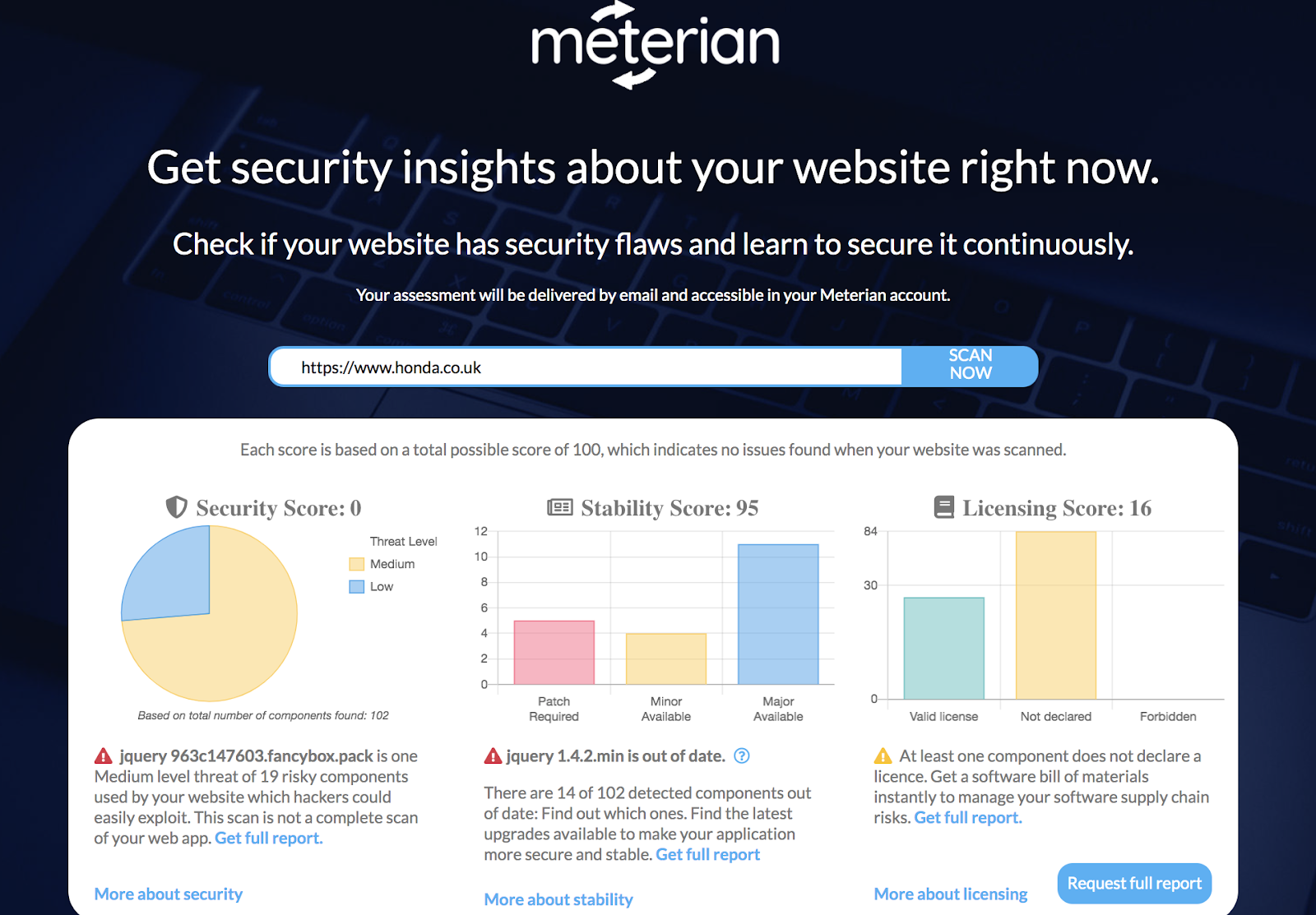
Earlier this month, Honda announced it has suffered a cyber attack on its network. It was affecting its operations around the world: their manufacturing plants have shut down, customer service work has been forced to stop, and their internal communication systems were affected. Additionally, systems outside of Japan were affected due to a “virus” that spread through the network. No further details on the root cause of the attack yet, but at Meterian we have done a quick surface scan of their websites honda.com and www.honda.co.uk. Similar issues were found on both. We’ll focus our blog post on Honda UK’s site.
From the summary report above, we see their website’s security scored 0 From the summary report above, we see their website’s security scored 0 out of 100 because it has 19 vulnerabilities, including jquery 1.4.2 which is vulnerable and outdated. Honda.co.uk’s basic cybersecurity hygiene could be improved by making sure to not launch the website with vulnerable and old components — jquery 1.4.2 is from 2010. Similar issues were found after analysing honda.com.
Although we don’t know if these two components’ weaknesses contributed to the hack of Honda’s systems, while investigations are private, we know every software application is part of a company’s digital estate. Altogether, front end systems (like websites and mobile apps) and back end systems (like databases, servers, APIs that store or access a company’s customer data, intellectual property — the real business logic of the services) make up the digital estate. Any security hole is a vulnerable entry point for cyber criminals to exploit and gain unauthorized access to information or systems to cause damage. Last year in 2019, over 40GB of Honda’s data were breached, exposing details about internal systems and devices on their network. Cyber criminals have strategically targeted Honda again.
There are many strategies to build up an organization’s cyber resilience, including cybersecurity cultural awareness among employees and operational and software development best practices. Meterian helps customers reduce the time to detect, mitigate and resolve issues in applications’ software supply chain. These known vulnerabilities are easy to fix with Meterian because:
1. Safe coding practices can be easily adopted into the software development lifecycle
2. Automated controls fit directly into the software development workflow for continuous monitoring
3. Meterian can be set up to run continuously and prevent such vulnerabilities from going live
Most importantly, developers are empowered to recognise and address the issue early with information at their fingertips. As stewards of software, they can automatically cyber-proof their apps with Meterian so the business can run continuously and avert giving unwanted prying eyes unauthorized access to systems and data.
To this day, Equifax’s mistake for not fixing a known security hole in its software application’s open source component still has consequences since the 2017 mega breach they suffered. See TechRadar’s lackluster review of Equifax’s identity theft protection service, which they did not include in their article “Best identity theft protection for 2020.”
Good practices in cybersecurity can help protect a company’s reputation and growth. As we’ve also seen following the EasyJet hack incident revealed in May, business productivity and customer satisfaction can be adversely affected due to any cyber hack incident. You can read our recent analysis on easyjet.com’s website.
To see if your own public assets have open source vulnerabilities that anyone could find out about (and exploit to enter your systems), try our webscanner or project scanner.