Urgent and Critical: Remote Code Execution in Apache Log4j needs immediate upgrade

Updated: 31 Dec 2021

5 minute read

This is a call to arms. All enterprise software maintainers of software using Java libraries need to check if their systems are affected by the newly discovered Apache Log4j vulnerability since its announcement on Dec 9, 2021. Since then several security vulnerabilities in the wild have been discovered.

CVE-2021-44832

Vulnerability Score: 6.6 (CVSS: 3.0 / AV: N / AC: L / PR: N / UI: N / S: C / C: H / I: H / A: H)
Platform: Java
Component: org.apache.logging.log4j:log4j-core
Affected versions: 2.0-alpha7 to 2.17.0 inclusive, except 2.3.2 and 2.12.4.
Fixed in version: 2.17.1

CVE-2021-44228

Vulnerability Score: 10.0 (CVSS: 3.0 / AV: N / AC: L / PR: N / UI: N / S: C / C: H / I: H / A: H)
Platform: Java
Component: org.apache.logging.log4j:log4j-core
Affected versions: all versions before 2.14.1, inclusive
Fixed in version: 2.15.0 but upgrade to 2.17.0 is required because of CVE-2021-45105

CVE-2021-45046

Vulnerability Score: 9.0 (AV:N/AC:H/PR:N/UI:N/S:C/C:H/I:H/A:H) (updated 18/12/2021)
Platform: Java
Component: org.apache.logging.log4j:log4j-core
Affected versions: all versions up to 2.15.0, excluding 2.12.2
Fixed in version: 2.16.0 but upgrade to 2.17.0 is required because of CVE-2021-45105

CVE-2021-45105

Vulnerability Score: 7.5 (CVSS: 3.0 (AV:N/AC:L/PR:N/UI:N/S:U/C:N/I:N/A:H)
Platform: Java
Component: org.apache.logging.log4j:log4j-core
Affected versions: all versions from 2.0-beta9 to 2.16.0, inclusive
Fixed in version: 2.17.0


Which systems does this affect?

Apache Log4j is probably the most common library used for logging in the Java ecosystem with over 400,000 downloads from its GitHub project. It is used in Java applications to log system and user activities, so there’s a serious possibility your Java software is using it. It is used, internally, by many other Apache frameworks such as Apache Flink, Apache Druid, Apache Flume, Apache Solr, Apache Flink, Apache Kafka, Apache Dubbo. It is also actively used in many other open source projects, like Redis, ElasticSearch, Elastic Logstash, Ghidra and many others.

Among all these open source components, one needs a special mention: Apache Struts. Yes, it is actively using Log4j. There exists a potential to trigger high-impact attacks against a wide variety of apps and services, similar to the scale witnessed in 2017. At that time, due to the vulnerability exploited in the Equifax megahack, 140 million customers’ data in North America and UK were breached. The latest version of Apache Struts, 2.5.28, uses by default Log4j version 2.12.21, which is vulnerable to this attack. This time, however, the scope for damage could be even wider, as Apache Struts is one of many Apache frameworks that use Log4j. 

The Java ecosystem is in very broad use in enterprise systems and web apps and many mainstream services are likely to be vulnerable. Therefore, software maintainers and developers should pay close attention to this vulnerability. 

This has been preliminary filed as CVE-2021-44228, and a subsequent vulnerability was also flagged, now filed under CVE-2021-45046.


Why does this threat demand an urgent patch?

This vulnerability allows the attacker to remotely execute code on your system, with the ability to gain complete control of the underlying servers.

This is actively exploited on the internet now and there is already a simple POC (proof of concept) available on the internet that explains how to do it. 

From https://www.wired.com/story/log4j-flaw-hacking-internet/:

“All an attacker has to do to exploit the flaw is strategically send a malicious code string that eventually gets logged by Log4j version 2.0 or higher. The exploit lets an attacker load arbitrary Java code on a server, allowing them to take control.  […]Minecraft screenshots circulating on forums appear to show players exploiting the vulnerability from the Minecraft chat function. On Friday, some Twitter users began changing their display names to code strings that could trigger the exploit. Another user changed his iPhone name to do the same and submitted the finding to Apple. Researchers told WIRED that the approach could also potentially work using email.”

If you maintain an enterprise system using Java software, you would need to update all affected applications, whether they are maintained directly by your organisation or your supplier organisation.

Within 2 days of the 2017 vulnerability being announced, several systems around the world were breached by exploiting the software weakness.  We do not want more cyber breaches of such scale and all need to react quickly to patch vulnerable systems.


How can I check if my system is affected?

If you maintain any software using Java libraries, check if you are using Apache Log4j.  Meterian BOSS scanner can be used to scan your codebase to identify all dependent software libraries.  If it is using Log4j, it will find the affected vulnerable versions and provide more information on how to mitigate this risk.

If you are a developer and you have access to the code, you can simply execute this command from your terminal:

$ mvn dependency:tree | grep log4j-core | grep compile
[INFO] +- org.apache.logging.log4j:log4j-core:jar:2.12.1:compile

If you see any response lines, check the version: if it’s below 2.16.0 (as in the above example) you may be affected.


My system has the vulnerable log4j library — how can I mitigate the risk?

There is a patched version of the library that resolves the issue.  Released by Apache Software Foundation, the solution is to immediately upgrade log4j to the latest log4j version 2.16.0.  The fixed version is available via Maven. 

If the library is coming from a transitive dependency (it’s not one of your direct dependencies, but a dependency of them) you can just include an override in your root pom.xml (or where applicable) and retest that it’s not there anymore with the command shown before:

    <dependency>
        <groupId>org.apache.logging.log4j</groupId>
        <artifactId>log4j-core</artifactId>
        <version>2.16.0</version>
    </dependency>

A set of mitigations, specific to the version you are using, are also available on the Apache Log4j website. The Apache Struts team provided specific advice on how to handle the issue.

If you are using an external product that runs with Java, you can also protect your systems by launching the JVM with this special parameter:

-Dlog4j2.formatMsgNoLookups=true

This is useful for tools like Jenkins, where you have control of the installation but you do not have control of the code, but please note that this does not protect against the latest CVE.


What can I do to proactively protect from such vulnerabilities?

We always suggest you regularly scan your software code bases. 


Are Meterian applications affected by the log4j vulnerability?

No. We have verified our applications and none are using log4j.  We maintain a continuous monitoring system to ensure our development operations are up to date with the latest known vulnerabilities in software components.   

Related references

Urgent and Critical: Remote Code Execution in Apache Log4j needs immediate upgrade

Update to terms and privacy policy

We have updated our terms and conditions and privacy policy as our business grows to serve more customers across the software industry in financial, cybersecurity, e-commerce, health, IT and telecommunications sectors.  We look forward to welcoming more customers who want to secure their open source software supply chain as part of secure app development. Software developers, security officers, quality assurance and legal compliance professionals can benefit from easy to read reports to streamline their decision making processes.

Get in touch to book a demo! 

Update to terms and privacy policy

Making the most of Christmas, Part 2

11 min read

In the second of our three part blog series as we lead up to Christmas, the Meterian Team shares with you shortcuts to make the most out of what you already have.  

A library, component, piece of code is reusable when it can be re-used in different parts of the same or different project with minimal to no need of code modifications. 

Scanning for, identifying, and patching open source dependencies in an application’s codebase is known as dependency management. This is a critical part of modern software development since nearly 100% of codebases are made up of open source components. These dependencies can be directly used by your application or indirectly used through transitive relationships. You can imagine the number of connected components if your software codebase has hundreds of modules.

Many vulnerabilities remain, leaving software applications unsecured

In our analysis of 1310 website applications,  the most popular component with a security vulnerability was jQuery.  Out of 332 javascript components used across all the web apps,  81% of the components had a security vulnerability.  All of these vulnerabilities could be easily removed by simply upgrading to jQuery 3.5.1.  It’s great that software is reusable, but beware of the invisible stakeholder who preys on out-of-date components’ security holes.  Like fresh food, software components also have a “best before” date.  To get the most out of them before they go bad and become easy pickings for malicious bot-scripts of hackers, keep your code’s dependencies up to date. This is best done programmatically rather than manually.

Neither software development nor cybersecurity teams can keep up with all the changes and fixes required to keep the code performant and secure. Therefore, knowing how to leverage the right tools to detect and patch in a timely manner can make a difference in preventing a cyber breach spoiling a company’s business and reputation. In a Ponemon study last year:

  • 60% of respondents said their organisations suffered a breach due to an unpatched known vulnerability where the patch was not applied
  • 62% were unaware that their organisations were vulnerable prior to the data breach
  • 52% of respondents said their organisations were at disadvantage in responding to vulnerabilities because they use manual processes

Earlier this year another Ponemon report highlighted the need for a programmatic approach to managing vulnerabilities as unpatched known vulnerabilities remain a significant risk: “Over six months, an average of 28% of vulnerabilities remain unmitigated, and organizations have a backlog of 57,555 identified vulnerabilities.” Remember, even just one vulnerability exploited could lead to a cyber breach. Furthermore, 60% of open source programs audited had a vulnerability that’s already been patched.

For this blog, we present the top 3 most popular components found from our survey of 1310 web applications past their “best before” date. Below are recommended substitutions for an alternative or updated component that is vulnerability free so you can #BoostOpenSourceSecurity in your software applications:

  • jQuery 1.12.4  -> Please update to jQuery 3.5.1
 1 high level threat:  Affected versions of jquery interpret text/javascript responses from cross-origin ajax requests, and automatically execute the contents in jQuery.globalEval, even when the ajax request doesn't contain the dataType option. 
 Recommendation: Update to version 3.0.0 or later. 
  • handlebars.js 4.0.11 ->  Update handlebars module to version >=4.6.0
 1 high level threat: Versions of handlebars prior to 3.0.8 or 4.5.3 are vulnerable to prototype pollution. It is possible to add or modify properties to the Object prototype through a malicious template. This may allow attackers to crash the application or execute Arbitrary Code in specific conditions.
 1 medium level threat: Affected versions of handlebars are vulnerable to Denial of Service. The package's parser may be forced into an endless loop while processing specially-crafted templates. This may allow attackers to exhaust system resources leading to Denial of Service.. Recommendation: Upgrade to version 4.4.5 or later. 
  • Twitter-bootstrap 3.x.x (3.3.7)  -> update to the next safe version 3.4.1
 1 high level threat: XSS in data-template, data-content and data-title properties of tooltip/popover
 1 medium level threat: In Bootstrap before 3.4.0,  XSS  (cross site scripting) is possible in the affix configuration target property. 

Remains of the day

At the end of the day, updating your application’s dependencies is easy if you know what to look out for, when to apply the update, and have an automated workflow to help you do this consistently and at scale.  Finding the right combination of open source components to help speed and secure your development is one example of how “Necessity is the mother of invention.” Meterian speeds up the task of keeping your open source dependencies up to date easily and continuously so developers can focus on the main course of innovating securely.

In the spirit of giving this Christmas and to fuel the creative cooks out there (perhaps you or that important person in your life who always makes sure a delicious meal is ready for you at dinner time!), here’s how to use leftover Christmas veg to make two speedy suppers:

Linguine with with cavolo nero and bacon

Serves: 4
Prep time: 10 minutes
Cooking time: 20 minutes

Ingredients
400g linguine
olive oil
6 slices smoked streaky bacon, cut into 1cm or bite size pieces
1 tbsp olive oil
2 shallots, finely chopped
2 garlic cloves, crushed
300g cavolo nero, hard stalks removed, and roughly chopped (shortcut: blitz the shallots, garlic and cavolo nero leaves in food processor until finely chopped)
75ml double cream (optional)
2 egg yolks
¼ nutmeg, freshly grated
50g parmesan cheese, finely grated
salt & freshly ground black pepper 

Tip: No cavolo nero?  Don’t get stuck in a rut.  Try any slightly bitter green veg, such as brussels sprouts, broccoli, broccolini, gai lan, or rapini.  All lend a lovely nutty flavour balanced with the delightful pungence of parmesan cheese and black pepper.

 Instructions
 Cook the linguine in a pan of boiling, salted water following the pack instructions. Meanwhile, heat some olive oil in a large frying pan, and cook the bacon for a couple of minutes. Add the shallots and garlic cloves, and finely chopped cavolo nero to stir-fry with the bacon.  After 3-4 minutes,  take off the heat.
Mix the cream and egg yolks with with the nutmeg, ⅔ of the cheese and some black pepper.
Put the bacon and veg stir fry back on the heat, add a little of the pasta cooking water and simmer down to 2 tbsp.
Drain the cooked pasta, and add the pasta to the pan with the cavolo nero-bacon and cream mixture. Next add the remaining grated parmesan cheese, and season with more salt and pepper to taste. 
Cod, Chorizo and Potato Stew

Serves: 4
Preparation time:10 minutes
Cooking time:30 minutes

Ingredients
110g chorizo, cut into 2cm slices
1 onion, sliced
1 garlic clove, crushed
4 potatoes
1 can of chopped tomatoes (220-250g)
500ml fish stock
600g frozen cod fillets, defrosted and cut into 3 - 4cm chunks
20g flat leaf parsley, chopped

Instructions
1. Heat a large pan over a medium heat and cook the chorizo for 2 - 3 minutes, then remove from the pan and set aside. Drain all but 1 tbsp of fat from the pan and use to cook the onion and garlic over a medium heat for 6 - 8 minutes until soft. Peel potatoes and cut into 3cm chunks.  Put the potatoes in the pan with the chorizo and cook for 3 minutes.
2. Add the tomatoes and fish stock, bring to the boil and simmer for 10 - 12 minutes until the potatoes are tender. Stir in the cooked chorizo. You can freeze the stew at this stage, letting it cool to room temperature first.
3. If cooking from frozen, defrost the stew overnight in the fridge or in a microwave, then reheat. Add the cod to the stew and simmer for 4 - 5 minutes until just cooked. Season and serve immediately, scattered with parsley.

“The evening’s the best part of the day. You’ve done your day’s work. Now you can put your feet up and enjoy it.”

― Kazuo Ishiguro, The Remains of the Day

The tools that boost your efficiency when your coding project has a handful developers may need to be very different from the software that keeps your project humming when you have 1,000 or more. We’ve designed Meterian to evolve with your application security tech stack as your software engineering and digital transformation needs evolve. If your open source dependency management system is not humming smoothly with your software development life cycle, or your open source components are decaying and reducing their life time value for the organisation, consider reusing and securing your software components with Meterian. Get in touch today.

Making the most of Christmas, Part 2

Making the Most of Christmas

Recipes, ingredients and ideas to make your fuel (food and software!) go further.

In this three part blog series as we lead up to Christmas, the Meterian Team will share with you their work and christmas holiday hacks of life.  First and foremost, let’s get our coding projects secured so we can have some peace of mind over the holidays.

Five things to do this December and then forgeddaboutit until 2021

1. Sign up to Meterian free trial (5 mins)

2. Run your Security, Stability, Licence check and get to know your components (20 mins)

3. Triage: Automatically fix out of date components, set exclusions or identify issues to discuss a mitigation plan. (30 mins)

4. Schedule your action plan (20mins)

5. Automate it to run continuously with your favourite CI, GitHub Action, or BitBucket Pipe so your software dependencies are checked without you needing to be interrupted during any of your Christmas socials. 

This last step will require you to put in some time and effort.  Our customers have done this in minutes to several hours over 2 days.  The best part is that once it’s done and you’ve got it running automatically, you can just leave it running and put your feet up.  Or perhaps run off and be there for someone else who needs you.  Boost your apps’ open source security — Enjoy!

Making the Most of Christmas

Cybersecurity and IoT: Health Care and Well-Being in our Shared Spaces

Last updated: 07/07/2021

As the extraordinary situation of the COVID-19 crisis continues and more such supervirus incidents will occur, the benefits that IoT can provide will be even in more demand.  We are already seeing how IoT plays a significant role in modernising healthcare and disaster prevention, public safety and security, supply chain, and manufacturing and production.  

The Good We’ve Seen

In Hong Kong, the government has deployed smart wristbands to monitor city residents1 quarantined inside their homes.  Accelerating the timely discovery of outbreaks, these smart medical devices, powered with internet of things (IoT) technology, play an important role in containment of outbreaks like COVID-19 and prevent future pandemics.

Prior to COVID-19 pandemic, Japan was preparing for Tokyo 20202, the smartest Olympics ever with self-driving cabs to transport guests between sports venues, robotic guides, immersive virtual reality and crowd control directed by artificial intelligence.  Getting ready to welcome 11,000 athletes with 4 to 7 million on-site spectators from Japan and all over the world, this would have been a wonderful showcase of IoT tech and applications from a country that is already a technological leader in robotics and consumer electronics.  Unfortunately, the event is postponed 12 months, though the Olympic Committee resolves to have the games, it’s not clear how much of IoT tech applications will be used.

As public venues have been opening up in the past several weeks, there is a serious challenge of getting business going and the health and safety of people using the same facilities.  How can public toilets be kept safe and clean for everyone to use?  A common need at medical centres, restaurants, shopping malls, and any city where visitors would rely on public toilets. One new IoT company on the scene, Inferrix, has a solution for the “COVID Secure Washroom”, as described on their website: Inferrix wireless edge-intelligent sensors on the washroom doors show a red light to alert visitors if the washroom is unsafe to use. Any washroom can be installed in less than 1 hour.  We can easily imagine its application to be useful in office spaces near shared kitchen areas or study areas of public or university libraries as well.

When we reflect on the role that IoT played over the course of the pandemic, there are more notable instances. For example, telehealth consultations meant that there was a reduced risk of transmission that would otherwise have been prevalent with face to face consultations. Secondly, robot assistance is used to disinfect contaminated areas and objects, both protecting health carers and giving health carers more time to care for their patients. China was the first country to use Danish made UVD robots using IoT and help to disinfect treatment areas in nursing homes and clean patient rooms.

The Not So Good

In a 2019 study of security of IoT devices3, data revealed that more than twice the number of vulnerabilities were detected compared to six years earlier.  As covered in in our last blog post, cyber attacks from IoT risks have surged 300% and the UK and US are catching up on regulations to ensure companies safeguard devices. In March 2020 researchers found4 that more than half of all internet of things (IoT) devices are vulnerable to medium- or high-severity attacks, with 98% of all IoT device traffic being unencrypted.

As we’ve seen during the COVID-19 crisis, even when everyone else was rallying together, cyber criminals targeted vulnerable organizations in the health sector: data-stealing ransomware on US pharma company5 and Europe’s largest private hospital6, Czech republic hospital’s computer systems were attacked when their focus was on running coronavirus tests, and in the UK two construction companies building emergency hospitals were hacked7.

Such attacks can become more sophisticated and more dangerous to individuals using new health technology apps and devices used to provide medication or daily survival needs.

Bringing Tech Out for Good

Connected devices are available using cellular connectivity which are allowing doctors to rely on patients to use connected out-of-the-box devices for special readings to be sent directly to the doctor from the device (temperature, blood pressure, glucose meters).   Such technology is not limited to medical practitioners and is already available for anyone.  A user created a smart system to monitor his diabetic brother’s blood sugar8 (glucose) levels using an app, a data logging platform that processed data from his brother’s glucose sensor to make his own healthcare monitoring system.

Similarly, Australia saw its first ‘virtual hospital’9 open shortly before the COVID-19 pandemic hit through Royal Prince Alfred Hospital (RPA) in Sydney. Data from pulse oximeters used to measure oxygen saturation levels and heart rates along with armpit patches to track temperature were transmitted to the hospital. In addition, video-consultations allow coronavirus patients to receive the care they need without the risk of transmission. 

Recently, we have seen evidence of health providers recognise the risks surrounding IoT devices and the need to incorporate security standards to protect against malicious hackers. For example, University Hospitals of North Midlands NHS Trust has opted to trust Ordr with providing a systems control engine (SCE)10 which will locate and secure every connected device. This includes Internet of Medical Things (IoMT), Internet of Things (IoT) and Operational Technologies (OT) devices.

Security, safety, and data privacy considerations are important aspects of designing, building and maintaining such systems to protect the identity and well-being of the individual.  We’d hate to think about incidents where devices give wrong information due to a malicious actor – getting the wrong medication, dosage, or advice could have serious, even lethal consequences.  Having IoT devices and apps to create a safer world requires more scrutiny and protective measures designed as part of the solution.  As many of these solutions will be designed for one person’s use, customised to their medical needs or specific daily routines, it’s essential they are maintained, updated, and when no longer maintainable that they are properly turned off and disposed of.

Check out IoT For All Podcast with Christopher Schouten of Kudelski Group11.  He talks about necessary considerations to secure IoT projects, making sure they can scale as well as be practical in protecting what is valuable. 

Although the transformational journey to an IoT world seems daunting, the capabilities of IoT to bring high-tech care and consultancy out of the clinic and into homes and vulnerable communities across the world presents a thrilling opportunity.  Health care and IT experts, technicians, research scientists and security experts are collaborating, as are carers, policy makers and administrators.  Altogether, the confluence of tech and human intelligence will continue to evolve and strive to protect all that is worth protecting.  COVID-19 and cybercrime are making seismic shifts in worldwide health and safety, threatening our prosperity. Let’s defend the world, use technology for good and build the world we want.

If you are a developer or have a software development team using open source components, learn how  Meterian automates monitoring of software applications for open source risks and vulnerabilities.  Read about Meterian-X: Invisible Security for your Open Source Security Management in IoT systems and devices.

1 Doffman, Zak. “Coronavirus Police Surveillance Tags Are Now Here: Hong Kong First To Deploy.” Forbes, 17 March 2020, https: //www.forbes.com/sites/zakdoffman/2020/03/17/alarming-coronavirus-surveillance-bracelets-now-in-peoples-homes-heres-what-they-do/?sh=227b12984533

2 Hallet, Rebecca. “Tokyo on track for smartest Olympics ever”. Raconteur, 20 February 2020, https ://www.raconteur.net/technology/internet-of-things/iot-tokyo-2020/

3 Coble, Sarah. “Vulnerabilities in IoT Devices Have Doubled Since 2013”. Info Security, 17 September 2019, https ://www.infosecurity-magazine.com/news/vulnerabilities-in-iot-devices/.

4 O’Donnell, Lindsey. “More Than Half of IoT Devices Vulnerable to Severe Attacks”. threat post, 11 March 2020, https:// threatpost.com/ half-iot-devices-vulnerable-severe-attacks/153609/.

5 Whittaker, Zack. “Hackers publish ExecuPharm internal data after ransomware”. Tech Crunch, 27 April 2020, https: //techcrunch.com/2020/04/27/execupharm-clop-ransomware/.

6“Europe’s Largest Private Hospital Operator Fresenius Hit by Ransomware”. KrebsonSecurity, 6 May 2020, https: //krebsonsecurity.com/2020/05/europes-largest-private-hospital-operator-fresenius-hit-by-ransomware/.

7 “Coronavirus: Cyber-attacks hit hospital construction companies” BBC News, 13 May 2020, https: //www.bbc.co.uk/news/technology-52646808.

8 Anx, Quintessant. “Healthcare IoT: Monitoring Diabetes with Logz.io” Logz.io, 11 December 2018, https: //logz.io/blog/healthcare-iot-monitoring/.

9 Minion, Lynne. “‘Flattening the curve’ with virtual care in Australia'” Healthcare IT News, 30 June 2020,  https: //www.healthcareitnews.com/news/europe/flattening-curve-virtual-care-australia

10 Crouch, Hannah. “University Hospitals of North Midlands deploys Ordr cyber security solution”. digital health, 6 May 2021, https: //www.digitalhealth.net/2021/05/university-hospitals-of-north-midlands-ordr/

11 “Security Challenges in the IoT Landscape | Kudelski Group’s Christopher Schouten”. iot for all, 5 May 2020, https: //www.iotforall.com/podcasts/e064-iot-security-considerations.

Cybersecurity and IoT: Health Care and Well-Being in our Shared Spaces

Cyber Security and IoT

Last updated: 07/07/2021

How can we enjoy social gatherings in restaurants or busy spaces again?  This is possible with robots, devices, space partitions and humans occupying the same space.  With imagination, we will re-create the bustling spaces redefined with IoT technology.

What is IoT? 

If you’re new to IoT, see from Wikipedia: “The Internet of things (IoT) is a system of interrelated computing devices, mechanical and digital machines provided with unique identifiers (UIDs) and the ability to transfer data over a network without requiring human-to-human or human-to-computer interaction.”1  

Basically, an IoT device is one that has an internet connection, even though normally it wouldn’t.  Your smart boiler and smart thermostat are examples of IoT devices. You talk to them using an app on your smartphone. You tell the smart boiler to heat water so you can take a shower, and the smart thermostat to warm up the room to a cosy temperature by the time you arrive home.

In recent months, as the reach and severity of the COVID-19 pandemic increased, adopting IoT solutions started joining the frontline in many countries outside Asia in order to manage the crisis. With the boost in increased use of digital and remote technologies, videoconferencing has become the norm for office meetings, school lessons and exercise classes.  The capabilities of video conferencing, email and messaging technologies has shown just how productive remote work can really be, with studies showing that 65% of pandemic remote workers wished to continue working from home and only 2% wished to return to the office.2

These efforts are likely to take a step further with IoT.  Many countries have set up temperature measurement systems at the entrance of public places such as airports and train stations.  Restaurant managers are also recording the temperature of staff who are preparing food.  If this collected data (temperature) could be transferred and analysed in the cloud through an app, it could result in real-time analysis. 

To orchestrate such a system requires planning and a clear understanding of what is most valuable to protect and why.  There are many benefits and use cases of IoT.

Benefits of IoT

IoT, artificial intelligence, and the analysis of vast amounts of real-time data sets (aka Big Data) can be used to slow down proliferation of pandemics to avoid future global health crises.  Such real-time connected intelligence, dubbed “nowcasting”, could be gained from medical devices connecting over the internet.  Trend monitoring of wearable devices could analyse population-level influenza trends daily according to a recent study from Scripps Research scientists.3

As seen during COVID-19 isolation period, this preventive action to stop the virus spread combined with telehealth services lets health care providers advise patients without risking exposure.

Robot surveillance for social distance monitoring can alleviate the stress on police or community patrol since robots don’t get tired of doing repetitive tasks — observe, record, count, report and take action. 4


Key reasons for implementing IoT projects are summarized in Microsoft Azure’s IoT survey featured in their IoT Signals report, which highlight the top three reasons as improving Safety and security, Operations optimization, and Quality assurance.

 Source: 2019 Microsoft Azure IoT Signals

During COVID-19 crisis, we have seen that doctors and health care providers can maintain some employees’ productivity while social distancing and relying on the right connected devices and computing systems.  Logistics companies, supermarkets and the food supply chain can track the quality and quantity of goods and produce from shore to shop or farm to market with minimal manual effort.  Eventually, the click-pick-and-collect journey of groceries delivered by Ocado5 will be done entirely with robotics. Another instance in which IoT can act as a useful tool for retail stores is by tracking consumer and employee location data. Michele Pelino, senior analyst in infrastructure and operations research at Forrester said, “The idea is to use information about location: GPS capabilities in phones. Over time, there will be more opportunities to create location-based experiences to interact with a brand”. Possibilities for the next year include the ability for customers to use GPS to check in, allowing them to maintain distance by avoiding queues.

IoT Risks

As with all new technology, great progress comes with risks in uncharted fields.  

Since the explosion of the internet of things (IoT) across industries, companies providing products or services in any IoT ecosystem must carefully evaluate and examine possible threats of malicious intent.

We have been warned children’s toys6 and baby monitors’7 cameras have been hacked by strangers invading privacy and security of the home.  In the UK, regulations for IoT devices are gradually being introduced to catch up with the 300% surge in cyberattacks using IoT devices8, and similarly in the US9.

In the United States, FBI warned 10 the US private sector in February: “Software supply chain companies are believed to be targeted in order to gain access to the victim’s strategic partners and/or customers, including entities supporting Industrial Control Systems (ICS) for global energy generation, transmission, and distribution”. Recently we have seen this exact industry area targeted in oil pipeline system company Colonial Pipeline’s Ransomware attack. This led to the take down of the largest fuel pipeline in the U.S., and Colonial Pipeline paying out a huge $4.4m crypto currency ransome.

 In addition to attacks against supply chain software providers, the FBI said the same malware was also deployed in attacks against companies in the healthcare, energy, and financial sectors.

The Most popular supply chain attack is 2017’s NotPetya ransomware attack11. Due to a lack of patches to keep software in their Windows computer systems up to date, cyber criminals were able to gain access to computers and install a malware that spread through the networks of organizations like wildfire.  Multinational companies, AP Moller-Maersk, Reckitt Benckiser and FedEx, were crippled and they were not even the target of the state-sponsored attack.  Just collateral damage, and the estimated loss is $10 billion12.  

Gavin Ashton recently wrote in his personal blog about his insider view of the NotPetya experience, which cost Maersk $300 million: “you should put up a damn good fight to stop these attacks in the first case. … Staying with the home analogy; Yes, there’s security cameras and wizard cloud-connected ‘Internet of Things’ (IoT) devices and all kinds of expensive measures and widgets, but a lot of organisations fail simply on the basics. Lock the damn door.”13

The Value Security Adds to Systems

Such risks and misfortunate events are avoidable and can be mitigated.  

There is a range of use cases in which security indeed adds value to IoT systems.  For example:

  1. Need to prove authentic origin of products such as fresh produce or medications? Eliminate loss by tracking products with encrypted data.
  2. Need to guarantee the integrity of data?  Prevent tampering and fraud by ensuring systems have security controls for identification, authentication and authorization.
  3. Prevent cloning/faking/tampering of trackers or meters?
    • Ensure data of logistics/transport/utility/food services is confidential end-to-end
    • individual contact tracing. Ensure tracker data is confidential end-to-end
    • Prevent device/software tampering that could affect pricing and billing
  4. At home and with health care providers, 
    • Safeguard customer privacy by preventing intrusion into home systems
    • Comply with patient privacy regulations by protecting data at rest (stored on devices/systems)  and in motion (when sent from a device over the network to another device/system).

In the IoT ecosystem, it is crucial for organizations to have visibility into all connected devices and systems. As more employees use cloud apps and mobile devices for work, the traditional network security perimeter has lost relevance. This means more attention is needed on endpoint monitoring and protection, which includes not only employees’ devices to perform work, but also devices in the worker’s environment whether at home or at work. At work the environment may be an open plan of office desks, a clinician’s patient room, or on the assembly line of a manufacturing plant.  Each environment will have its unique characteristics.  For more on the role of IoT and the fight against COVID-19 in sensitive areas, read our blog: Cyber Security and IoT: Health Care and Well-Being in our Shared Spaces.

The user/actor in the environment may also vary and the device’s mobility would affect its position and environment.  IoT system design must take many of these factors into consideration and use secure-by-design principles to protect the value of the information that is being moved around the ecosystem.  There is no panacea to protect all aspects because in the IoT ecosystem the hardware, software, and services are provided by different vendors.   Each aspect will need to be secured to be fit for its purpose within the context of its environment and ecosystem.  Methods to update and/or remove devices are required to keep up with the pace of business and technological advancements.

Just as hardware devices come with basic security benefits that can be used and will need to be updated over time, the software of open source components used by IoT devices must also be maintained.  Continuous updates are essential.  New aspects of information and human security will need to be included.  In the context of autonomous vehicles, software must be resilient against both malicious actors as terrorists as well as unauthorised but friendly users, such as a child who could use a smartphone to direct the car to go to school, for example.

Look Out Ahead for CyberSecurity in IoT

The future is not promising to be better in terms of cybersecurity threats and malicious attacks.   Globally there were nearly 27.5 billion installed IoT devices number of installed IoT devices at the end of 2020, which is set to rise to 45.9 billion by 202514. So, with both of these figures growing, it is clear to see that IoT devices are the perfect vessel for cyber criminals to carry out attacks.

80% of data breaches can be prevented with basic actions, such as vulnerability assessments, patching, and proper configurations.  Getting basic cyber hygiene right is critical to help prevent cyber attacks.  There are always those who destroy unity and stifle positive progress.  Cyber criminals unfortunately will continue to innovate with artificial intelligence to increase their attacks at machine speed from anywhere in the world and on a scale comparable to that of a pandemic.

How a Software Bill Of Materials can help prevent cyber attacks

The National Telecommunications and Information Administration (NTIA) defines a Software Bill Of Materials (SBOM) as “a complete, formally structured list of components, libraries, and modules that are required to build (i.e. compile and link) a given piece of software and the supply chain relationships between them. These components can be open source or proprietary, free or paid, and widely available or restricted access.” A bill of materials such as this acts as a comprehensive compilation of all internal parts of the software, including third party contributions. This would facilitate the tracking of individual components such as libraries or source code within software programs. With a complete and traceable inventory, companies can see and manage the risks associated with open source libraries by identifying vulnerable systems as early as possible. Furthermore, it allows developers to monitor what components they use by vetting the code in their projects. Finally, this level of transparency would allow for a more informed purchasing experience for consumers. President Biden recently formalized the importance of SBOMs through the Executive Order on Improving the Nation’s Cybersecurity15, in which it was made mandatory that all software used by the US government came with its own SBOM— so as to prevent from SolarWinds type hacks in the future.

If you are interested in automated auditing of your software applications for open source compliance risks and security vulnerabilities, get in touch.

1 Wikipedia, https ://en.wikipedia.org/wiki/Internet_of_things

2 Mlitz, Kimberly. “Work from home & remote work- Statistics and Facts”. Statistica, 30 March 2021, https: //www.statista.com/topics/6565/work-from-home-and-remote-work/.

3 “Fitness wearables may improve real-time tracking of seasonal influenza outbreaks.” Scripps Research, 16 January 2020, https ://www.scripps.edu/news-and-events/press-room/2020/20200116-wearable-flu.html.

4 Stieg, Cory. “This $75,000 Boston Dynamics robot ‘dog’ is for sale—take a look”. Make it, 22 June 2020, https ://www.cnbc.com/2020/06/22/75000-boston-dynamics-robot-dog-for-sale-take-a-look.html.

5 Banks, Martin. “Google Solving Together – Ocado Technology readies clients for more changes to online retail’s ‘new normal”. 15 June 2020, https ://diginomica.com/google-solving-together-ocado-technology-readies-clients-more-changes-online-retails-new-normal

6 “What did she say?! Talking doll Cayla is hacked”. 30 January 2015, https ://www.bbc.co.uk/news/av/technology-31059893 .

7 “Smart camera and baby monitor warning given by UK’s cyber-defender”. BBC News, 3 March 2020, https ://www.bbc.co.uk/news/technology-51706631.

8 Kelly Early. “What do the UK’s newly proposed IoT laws look like?”. Silicone Republic, 28 January 2020, https ://www.siliconrepublic.com/enterprise/uk-iot-internet-of-things-regulation-laws.

9 https ://www.nist.gov/internet-things-iot

11 Cimpanu, Catalin. “FBI warns about ongoing attacks against software supply chain companies”. ZD Net, 10 February 2020, https ://www.zdnet.com/article/fbi-warns-about-ongoing-attacks-against-software-supply-chain-companies/

12 Hall, Kat. “Largest advertising company in the world still wincing after NotPetya punch”. The Register, 7 July 2017, https ://www.theregister.com/2017/07/07/ad_giant_recovering_from_notpetya/.

13 Ashton, Gavin. GVNSHTN, Maersk, me & notPetya, 21 June 2020, https ://gvnshtn.com/maersk-me-notpetya/.

14 Belton, Padraig. “In 2021, as you work from home hackers eye your IoT”. Light Reading, 1 April 2021, https ://www.lightreading.com/iot/in-2021-as-you-work-from-home-hackers-eye-your-iot/d/d-id/766350

15 “Executive Order on Improving the Nation’s Cybersecurity”. The White House, 12 May 2021, https ://www.whitehouse.gov/briefing-room/presidential-actions/2021/05/12/executive-order-on-improving-the-nations-cybersecurity/.

Cyber Security and IoT

Meterian Spotlight: A quick look at Honda’s open source software supply chain

Photo of front view of white honda car with headlights on at dusk
Photo by Douglas Bagg on Unsplash

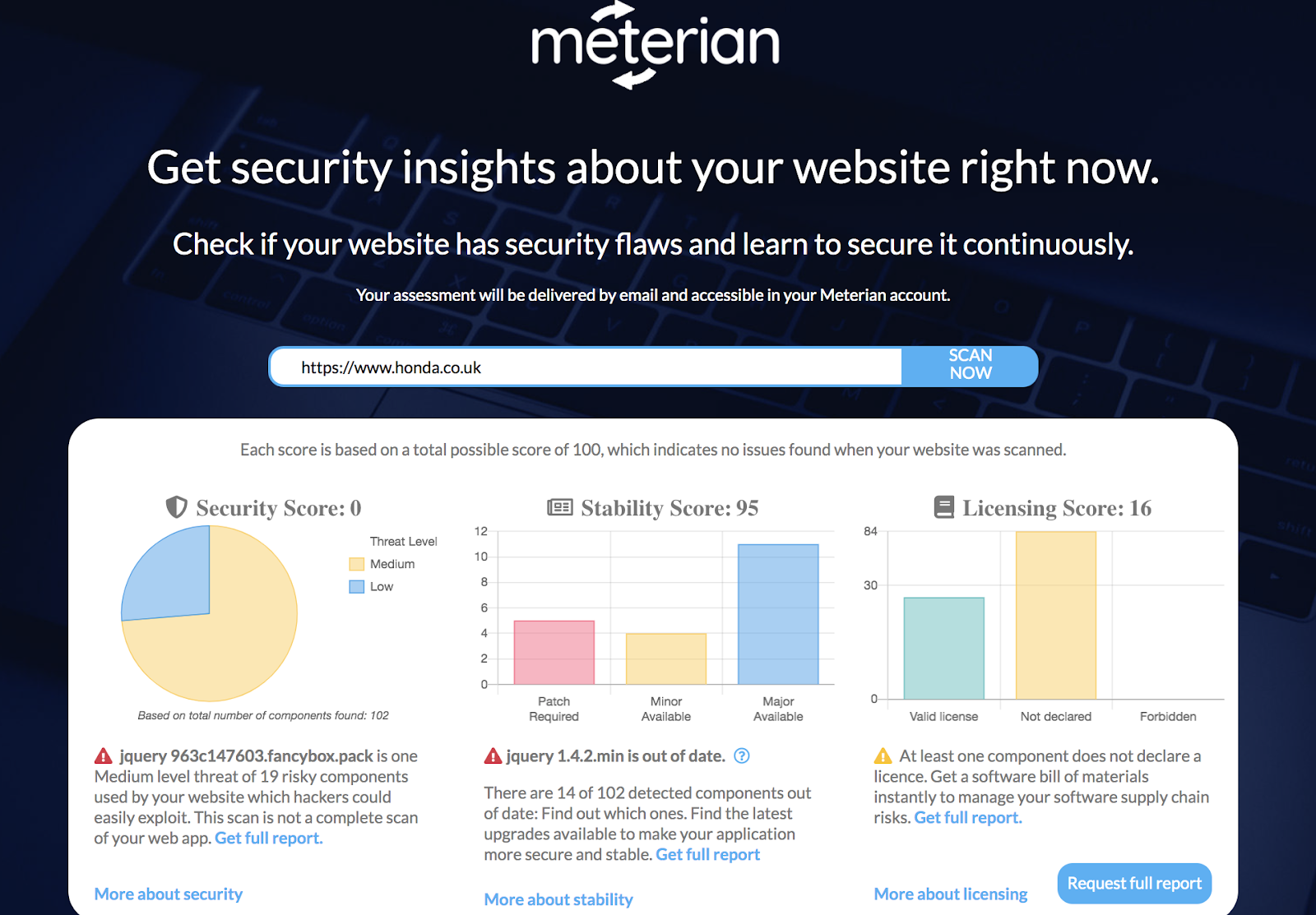
Earlier this month, Honda announced it has suffered a cyber attack on its network.  It was affecting its operations around the world: their manufacturing plants have shut down, customer service work has been forced to stop, and their internal communication systems were affected.  Additionally, systems outside of Japan were affected due to a “virus” that spread through the network.  No further details on the root cause of the attack yet, but at Meterian we have done a quick surface scan of their websites honda.com and www.honda.co.uk.  Similar issues were found on both.  We’ll focus our blog post on Honda UK’s site.

From the summary report above, we see their website’s security scored 0 From the summary report above, we see their website’s security scored 0 out of 100 because it has 19 vulnerabilities, including jquery 1.4.2 which is vulnerable and outdated.  Honda.co.uk’s basic cybersecurity hygiene could be improved by making sure to not launch the website with vulnerable and old components — jquery 1.4.2 is from 2010.  Similar issues were found after analysing honda.com.

Although we don’t know if these two components’ weaknesses contributed to the hack of Honda’s systems, while investigations are private, we know every software application is part of a company’s digital estate.  Altogether, front end systems (like websites and mobile apps) and back end systems (like databases, servers, APIs that store or access a company’s customer data, intellectual property — the real business logic of the services) make up the digital estate.  Any security hole is a vulnerable entry point for cyber criminals to exploit and gain unauthorized access to information or systems to cause damage.  Last year in 2019, over 40GB of Honda’s data were breached, exposing details about internal systems and devices on their network. Cyber criminals have strategically targeted Honda again.  

There are many strategies to build up an organization’s cyber resilience, including cybersecurity cultural awareness among employees and operational and software development best practices.  Meterian helps customers reduce the time to detect, mitigate and resolve issues in applications’ software supply chain. These known vulnerabilities are easy to fix with Meterian because:

1. Safe coding practices can be easily adopted into the software development lifecycle  

2. Automated controls fit directly into the software development workflow for continuous monitoring

3. Meterian can be set up to run continuously and prevent such vulnerabilities from going live 

Most importantly, developers are empowered to recognise and address the issue early with information at their fingertips.  As stewards of software, they can automatically cyber-proof their apps with Meterian so the business can run continuously and avert giving unwanted prying eyes unauthorized access to systems and data.

To this day, Equifax’s mistake for not fixing a known security hole in its software application’s open source component still has consequences since the 2017 mega breach they suffered.  See TechRadar’s lackluster review of Equifax’s identity theft protection service, which they did not include in their article “Best identity theft protection for 2020.”   

Good practices in cybersecurity can help protect a company’s reputation and growth.  As we’ve also seen following the EasyJet hack incident revealed in May, business productivity and customer satisfaction can be adversely affected due to any cyber hack incident.  You can read our recent analysis on easyjet.com’s website.  

To see if your own public assets have open source vulnerabilities that anyone could find out about (and exploit to enter your systems), try our webscanner or project scanner.

Meterian Spotlight: A quick look at Honda’s open source software supply chain

Vulnerability Focus: Javascript

Welcome back to Meterian’s next Vulnerability Focus report edition. This week we are talking about Javascript vulnerabilities which need to be addressed. Both have been published in recent months and have a medium severity threat. The first vulnerability could result in a cross-site scripting attack whilst the second is to do with a cryptographic issue. There are over 1.6 billion websites in the world, and JavaScript is used on 95% of them, be sure to check if you could be affected.

  • CVE-2019-12043: there is a vulnerability in remarkable 1.7.1 affecting the unknown processing in the library lib/parser_inline.js of the component URL Handler. Manipulation of this component can lead to cross-site-scripting.
  • CVE-2019-9155: OpenPGP.js has a cryptographic issue which could allow attackers to conduct an invalid curve attack and gain the victim’s ECDH private key

CVE-2019-12043

Vulnerability Score: 6.1

Platform: Javascript

Components: remarkable version 1.7.1

Read up Javascript users! This vulnerability was posted last year in 2019, yet because of the significant amount of people using Javascript for their web apps, we thought it would be useful to inform people who might not have had time to address the issue. 

This vulnerability has been found in remarkable 1.7.1 and is considered problematic. The component mishandles URL filtering, which allows attackers to trigger an XSS attack via unprintable characters.

Cross site scripting is an injection of malicious code into a trusted web app. As described above, this happens when the user input is not sufficiently validated either on the client or server side. The scripts injected will have malware which then allows the hacker to do a series of exploits. What is more concerning is that the attack could then alter the appearance of the web app and also commence attacks on users visiting that site.

An image of a computer with three people huddled around it, pointing at the screen.
https://unsplash.com/photos/2FPjlAyMQTA

The solution for this vulnerability is to replace remarkable 1.7.1 with versions 1.7.4 to 2.0.0.

CVE-2019-9155

Vulnerability Score: 5.9

Platform: Javascript openpgp

Components: openpgp versions up to 4.2.0 included

This Javascript vulnerability was published in September 2019 and has a medium severity score of 5.9. 

The vulnerability is a cryptographic issue in OpenPGP.js up to and including 4.2.0. This is a library in Javascript and therefore can be used on nearly any device. Users do not have to install a gpg on their machines in order to use this library, and therefore it can be reused in other projects that have browser extensions or server apps. Its main function is to sign, encrypt, decrypt and verify any kind of text, specifically emails. 

The problem allows hackers, who can provide forged messages and get feedback on whether decryption of these messages succeeded, to eventually figure out and extract the victim’s private key.

An image of a key.
https://unsplash.com/photos/Nel8STCcWy8

To avoid this type of attack in the future, developers should identify sensitive data and encrypt them, even if stored on a hard drive. There should also be an effort to ensure the data cannot be overwritten by overwriting sensitive memory locations straight after the data is no longer needed in memory. 

In regards to this specific vulnerability, it is suggested to upgrade openpgp to version 4.3.0 or above. 

That is it from us…for now! Make sure to spread the word on these Javascript vulnerabilities in order to help protect your apps or the apps you develop. Read also our post about javascript vulnerabilities and remote code execution. 

As you all know, open-source vulnerabilities are discovered daily, so you can expect us to be back with new vulnerabilities very soon!

Knowing is half the battle. The other half is doing. Let Meterian help your dev team stay in the know and on top of the latest updates to secure your apps continuously. Sign up here to download the Meterian client today. You’ll get an instant analysis of your first project for free.  See the risks immediately and know which components to remove or upgrade to secure your app.

Vulnerability Focus: Javascript

The Automotive Industry: Cyber Hacks. A Growing Threat.

5min read

The inside of a car, looking out into the motorway.
https://unsplash.com/photos/MyjVReZ5GLQ

There is no question that the automotive industry is one undergoing constant innovation and digital transformation. Nowadays, people expect to stay connected when commuting in their vehicles at all times and locations. Modern cars will have built-in navigation systems, Wi-Fi access, as well as in-vehicle infotainment systems (a combination of entertainment and information delivery to drivers). Alas, with the rise of new technologies, comes the rise of new hacks and gateways for cyber criminals to penetrate car systems. 

Yet, it is also true that these cyberattacks are not just occurring out of new technologies, there is still clearly a lack of scrutiny over vulnerable open-source components within a company’s software code. This is confirmed by a 2019 survey by Synopsys and SAE International on current cybersecurity practices which found 62% of professionals interviewed believe malicious attacks on software and open source components are bound to occur in 2020 within the automotive industry. Clearly, these security holes are major contributors as to why malicious actors have been so successful in penetrating systems and networks. 

This article intends to enlighten readers on the problems which certain hacks can cause to the automotive industry and its customers, as well as insight into ways this industry could prevent future exploits as part of their digital transformation. 

What can go wrong?

Cyberattacks to the automotive industry can have health, financial and reputational consequences. Take the examples below:

  1. A scary reality is if the hackers access the brakes or steering wheel. We have already seen an example of this in April 2019, where a hacker broke into two GPS tracking apps (ProTrack and iTrack). This resulted in access to personal data, the monitoring of the vehicle location and the ability to stop the engine altogether. This type of hack could cause serious accidents and therefore threatens the health and safety of the passenger.
  1. Automakers also have to take care of cybersecurity within their designs or else they could suffer severe financial repercussions. For example, a global automaker recalled around 1.4 million cars in 2015 due to cybersecurity risks, resulting in the potential cost of the OEM (Original Equipment Manufacturer) of nearly $600 million. The impact here is not only financial loss, but the automaker loses a certain amount of credibility as a provider, further damaging their business.
  1. Losing control of a web or mobile app also has its downfalls. Ransomware attacks or data breaches could expose a lot of sensitive data, as well as stop systems from running. As automotive companies compile a significant amount of this customer data, they become a plausible target for hackers. For example, in April 2019, Toyota announced a breach had exposed the data of up to 3.1 million customers. This disrupts the business, causes financial problems and most certainly diminishes the reputation of the company. Additionally, the leaking of software IP can also be damaging to a business, as it can give information to hackers for future exploits.

Cybersecurity is like a seatbelt

A driver with a seatbelt.
https://unsplash.com/photos/stLYAO8Vx1E

Until 1966, cars were often made without seat belts. But now, it would never cross the mind of any manufacturer to not include seatbelts in the design of a car, as it would be a major risk to the health and safety of the passenger. Here we can make a parallel with cybersecurity. In the same way there is a blatant risk of not wearing a seatbelt due to the possibility of a car accident, there is also a major risk of letting software-driven devices run without having secured their entire software supply chain to de-risk the possibility of a cyber attack via a vulnerable software component.  Everyone should wear a seatbelt in a car, so why does the automotive industry not treat cybersecurity with the same mentality? 

It is suggested the automotive industry lacks a standard approach for dealing with cybersecurity. This problem can stem from the relationship between OEMs and suppliers. Currently, contractual arrangements often do not allow OEMs to test the end-to-end cybersecurity of a vehicle platform made up of parts from different suppliers. Subsequently, this makes it hard to achieve strong cyber security when automotive software is developed and tested. 

Businesses within the car industry, may feel that they haven’t got the time to focus on cybersecurity. Too many companies will not feel the urgency until they have experienced a cyber attack themselves. For that reason, there seems to be a shortage in cybersecurity professionals globally. A Cybersecurity Workforce study has interviewed over 3200 security professionals around the world and found that the number of unfilled positions has risen from 2.93 million in 2018 to 4.07million in November 2019.

How to improve cybersecurity in a constantly evolving industry?

For manufacturers and suppliers in the automotive industry, there is a need to prioritise cybersecurity as part of the automobile’s e-safety. Collaborators in the automobile value chain must take into consideration the digital life cycle of the vehicle’s software as part of the vehicle’s holistic life cycle. Therefore producers of intelligent cars (or their electronic subcomponents) powered with software must include these 4 pillars:

  1. A good baseline: understanding the relevant legislation in the OEM markets and making sure to uphold all the existing cybersecurity standards involved. This will help all parties deliver secure software.
  1. Enforce a security-by-design culture within the engineering process. This should focus on secure development practices, software testing and new supplier-audit processes that include cybersecurity issues. Here there should also be testing or evaluating the components within code, to check for vulnerabilities.
  1. Monitor the cybersecurity of cars on the road. This means having a clear view of a vehicle’s configuration and setting up a security operations center for cars. Here the center could use correlation and artificial intelligence to detect adverse events and respond efficiently. The use of new technologies adds to how the industry needs to digitally transform to address cybersecurity effectively.
  1. Ensure software updates to vehicles pass security and safety tests. This should be run by the OEM through a software-engineering approach. This shows automakers are testing and securing changes to the vehicle as part of their continuous maintenance.
A car in a factory, being constructed by machines.
https://unsplash.com/photos/jHZ70nRk7Ns

For other business providers working within the automotive industry it is also important to adapt to changing technologies so that your cybersecurity is up to date. For example, there are many companies now promoting different ways to own a car through web and mobile apps and shared-platforms such as Turo, Drover or Avis. Here criminals could target the business because of the abundance of sensitive customer data. This could be supported when Verizon’s Data Breach Investigation report saw 60% of the time, web apps are the unlocked doors that hackers use to access user data or bring your business to a stand still. These are some tips to protect your apps:

  1. Make sure to secure vulnerabilities within your business code – more than 40% of cyberattacks originate in software servers, vehicle mobile apps and the infotainment system combined. Addressing software vulnerabilities should be a consistent practice as they are discovered daily and hackers exploit them automatically using bots and programs. The scale of vulnerabilities which a company could obtain over time is seen through the example of Uber who have 1,345 resolved bug reports and have paid out over $2.3 million. To understand the scale, Uber has received up to 111 bug reports in the past 90 days.
  1. Implement a cyber resilient culture within your business. To go through digital transformation, companies need to adapt to the growing sophistication of cyber criminals. This means there needs to be qualified teams with expertise ready and prepared to respond to malicious actors. Clearly this is something which needs to be implemented with more rigour in the automotive industry, as FleetNews’ recent survey of 500 businesses in the sector found that 65% did not have a cyber security team. 
  1. Look into the future. When investing in new technologies, understand how this will impact your business models, operational processes and the user experience. Successful transformations also depend on how firms manage digital transformation process through leadership and governance (not solely its implementation). If businesses don’t keep up with evolving technologies, how will they be able to keep up with the growing sophistication of hackers? Research by Accenture has highlighted the advantage which digital transformation provides to companies: early innovators are 67% more likely to outperform compared to 18% for market share protectors.

Let Meterian be your seat belt

Meterian can automatically inventory your open source components and analyse them to check if they are up-to-date or have any publicly disclosed security and licence risks. Get started on building a proactive defence for your customer data and software IP as your business goes through digital transformation. Try our FREE web scanner today to get a preview of what kind of potential vulnerabilities are in your website.  We can provide more in-depth analyses for all your software code bases. Get in touch today.

The Automotive Industry: Cyber Hacks. A Growing Threat.

Attention! New .NET Vulnerabilities

4min read

Image of dark room with an open door. Label on the left saying 'Vulnerabilities .NET'

Greetings App Sec community! Meterian is back with some .NET vulnerabilities which need some attention. Both these vulnerabilities are of a medium to high threat nature, so make sure to give this a read, it’ll be worth your while. The first case deals with a cross-site scripting vulnerability, whilst the second can cause a core denial of service issue. Don’t let hackers use this as a backdoor to your systems and networks. Stay protected people!

  • CVE-2019-1301: .NET Core suffers from a denial of service vulnerability when it improperly handles web requests.
  • CVE-2019-12562: There is stored cross-site scripting vulnerability in DotNetNuke (DNN) versions before 9.4.0, allowing attackers to store and embed malicious script into the administration notification page.

CVE-2019-1301

Vulnerability Score: 7.5/HIGH

Platform: .NET

Components: 

Affected Versions: 

  • .NET Core  / Microsoft.NetCore.App: 2.1.0-2.1.12 or 2.2.0-2.2.6
  • System.Net.Sockets: 4.3.0

The first .NET vulnerability we bring to your urgent attention is a denial of service vulnerability which occurs when .NET Core improperly handles web requests. The affected versions are in any .NET Core based application running on .NET Core 2.1.0 to 2.1.12 or 2.2.0 to 2.2.6, and System.Net.Sockets 4.3.0. This is regarded as a high threat to security and should be tended to immediately.

How can you confirm if your .NET application is affected? Run the dotnet –info command to see the list of the versions you have installed. You will then see output as shown below:

Lines of code which show the if your .NET application is affected.
https://github.com/dotnet/announcements/issues/121

If you see that you have a version of .NET Core which is less than 2.1.13 or less than 2.2.7, then unfortunately you are vulnerable. The same applies if you are using the meta-package “Microsoft.NETCore.App”, with the same version range. Please note that this also applies to the package System.Net.Sockets version 4.3.0.

What is .NET Core? It is an open source, development platform which is maintained by Microsoft and the .NET community on GitHub. It can be used to build device, cloud and IoT applications. 

Why is this vulnerability such a threat? Firstly, the attacker who is successful in the exploit of this vulnerability would use the denial of service against the .NET Core web application. Not only can this vulnerability be exploited remotely, but also without authentication of the user-cum-attacker. A denial of service attack (DoS) is focused on making a resource unavailable for the purpose of its design. The unavailability of a resource can come in many forms: manipulating network packets, programming, logical or resource handling vulnerabilities. Sometimes the attacker may execute arbitrary code to access critical information or execute commands on the server. Generally, this type of attack would cause response delays, large-scale losses, interruption to services and therefore an impact on availability. 

So how can you fix this issue? It is recommended to install the latest version of .NET Core but it depends on the versions which you have already installed. You may need to update if you have either version 2.1 (upgrade at least to 2.1.13) or 2.2 (upgrade at least to 2.2.7). If you are using the meta-package, upgrade the meta-package following the same version numbering. Also, if you are using System.Net.Sockets, please upgrade to version 4.3.1

CVE-2019-12562

Vulnerability Score: 6.1/MEDIUM

Platform: .NET

Component: DotNetNuke

Affected Versions: up to 9.4.0

You read right.  DotNetNuke (DNN) has a cross-site scripting vulnerability before versions 9.4.0 which is allowing remote attackers to store and embed malicious script into the admin notification page. The success of this exploit occurs when an admin user visits a notification page with stored cross-site scripting. 

A little information on DNN. First of all, it is a program that runs on Microsoft ASP.NET. It is also a framework, meaning it is a program designed to be extended. When you install DNN it can allow the creation of thousands of individual portals. These portals can then display pages and the pages display modules. More importantly, DNN is an open source web content management system meaning many businesses around the world rely on it for organisational purposes. DNNSoftware.com has over 1million registered members since 2013 and is used on nearly 750,000 websites globally. This might illuminate how many people could be affected by this vulnerability and why this needs urgent attention to avoid getting hacked.

The severity of this vulnerability is emphasized through the fact that stored cross site-scripting is the most dangerous type of cross-site scripting. The exploit could be used to perform any action that has administrator privileges. This includes: managing content, adding users, uploading backdoors to the server and more. 

Once this vulnerability had been detected it was reported to the DNN Software Security Department who have fixed the problem and released a patch. Users should update to the latest version 9.4.0 of DNN to avoid any security holes within their systems and networks. 

That is it from us…for now! Make sure to spread the word on these .NET vulnerabilities in order to help protect your apps or the apps you develop. But as you all know, open-source vulnerabilities are discovered daily, so you can expect us to be back with new vulnerabilities very soon!

Knowing is half the battle. The other half is doing. Let Meterian help your dev team stay in the know and on top of the latest updates to secure your apps continuously.  Sign up here to download the Meterian client today.  You’ll get an instant analysis of your first project for free.  See the risks immediately and know which components to remove or upgrade to secure your app.

Attention! New .NET Vulnerabilities