Meeting Compliance Challenges in Healthcare: How Cybersecurity Partnerships Can Lead to Success

As healthcare companies face a complex web of EU and US regulations, understanding and adhering to these standards is crucial for maintaining trust and operational continuity. Regulations such as the EU’s Medical Device Regulation (MDR), the Network Information Security (NIS) directive, and upcoming legislation like the Cyber Resilience Act (CRA) and Digital Operational Resilience Act (DORA) demand meticulous compliance and robust cybersecurity measures.

Specifically, MDR requires stringent oversight of software used within medical devices, demanding thorough documentation and regular updates to ensure safety and performance. Meterian simplifies these tasks by automating the detection of vulnerabilities and outdated components in software, facilitating compliance through comprehensive Software Bill of Materials (SBOMs). These SBOMs provide a detailed inventory of all software components, crucial for MDR compliance, and help healthcare organisations maintain the integrity and security of their medical devices. By streamlining these processes, Meterian not only aids in meeting regulatory requirements but also enhances operational efficiency and reduces the risk of non-compliance penalties.

Meterian stands as a pivotal ally for healthcare companies navigating these regulatory landscapes. By offering tools that facilitate compliance with these stringent regulations, Meterian ensures that healthcare providers can focus more on patient care and less on the nuances of cybersecurity compliance.

The conversation around SBOMs and compliance is growing, and Meterian is leading these discussions with healthcare companies, showcasing how automation and detailed compliance reporting can ease the burden on healthcare providers. Whether it’s a startup or a seasoned enterprise, Meterian’s scalable solutions fit diverse budgets and operational scales, making comprehensive cybersecurity accessible to all healthcare entities.

By partnering with Meterian, healthcare companies not only ensure compliance with current regulations but also prepare for future legislative changes. Meterian’s proactive approach helps companies anticipate and adapt to the regulatory landscape, ensuring that they are always one step ahead in their cybersecurity measures.

Are you ready to elevate your healthcare organisation’s compliance and cybersecurity strategy? 

Partner with Meterian today to ensure that your technology infrastructure meets the stringent demands of regulations like the NIS Directive and MDR. Don’t wait until a cybersecurity incident occurs – take proactive steps to safeguard your patient data and systems. 

Visit our website or contact us to learn how Meterian can help your healthcare organisation stay secure, compliant, and resilient in an ever-evolving digital landscape. 

Meeting Compliance Challenges in Healthcare: How Cybersecurity Partnerships Can Lead to Success

Ensuring Data Integrity and Security in Healthcare: The Crucial Role of Application Security

In the digital age, healthcare companies are guardians of vast amounts of sensitive user data, ranging from personal health records to financial information. With this responsibility comes the challenge of ensuring data integrity and security against the growing threats of cyberattacks and data breaches. Meterian, a leader in application security, is at the forefront of providing solutions that safeguard this critical data.

Healthcare providers harnessing open-source software face unique security risks that require vigilant management and protection strategies. Meterian’s innovative tools actively scan and identify vulnerabilities within applications, ensuring that all components are up to date and secure against potential threats. By leveraging Meterian’s capabilities, healthcare companies can not only protect their patient data but also enhance their overall cybersecurity posture.

Protecting patient records.

In collaboration with Emis Group, a well-established brand in healthcare technology, Meterian has demonstrated its value in real-world applications. Emis has utilised Meterian’s solutions to bolster their applications’ defences, thereby protecting millions of patient records. While our partnership with Emis illustrates Meterian’s capability to handle the complex cybersecurity needs of large enterprises, it’s important to recognise that our solutions are equally effective and accessible for SMEs and startups. Meterian understands the unique challenges faced by smaller organisations, including tighter budgets and limited resources, as our platform is designed to be flexible and scalable.

For healthcare organisations, the fear of missing out on the highest level of security should be a significant concern. Meterian provides an essential layer of security that automates and streamlines the detection and management of vulnerabilities—tasks that would otherwise consume valuable development resources. As legislation evolves and compliance becomes even more stringent, Meterian’s tools help healthcare companies stay ahead, ensuring they meet all regulatory requirements while securing user data against emerging threats.

A successful case study.

To see first – hand how Meterian is enhancing cybersecurity in the healthcare industry, we invite you to explore our success story with Emis Group. This case study provides a detailed look at how Emis leveraged Meterian’s cutting-edge solutions to fortify their application security, ensuring compliance with stringent regulations and protecting sensitive patient data. 

Visit Meterian today!

Ensuring Data Integrity and Security in Healthcare: The Crucial Role of Application Security

Discover Meterian at CyberUK 2024

The UK government’s flagship cyber security event, CyberUK 2024. is just around the corner! Hosted by the National Cyber Security Centre (NCSC), this annual gathering brings together over 2,000 cyber security leaders and professionals for networking, knowledge exchange, and collaboration.

Deputy Prime Minister Oliver Dowden recently announced the theme for CYBERUK 2024 during a speech at techUK. The focus will be on how the cyber community can harness the societal benefits of emerging technologies while ensuring their security for the future. This theme is particularly relevant as we navigate the ever-evolving landscape of cyber threats and opportunities.

What to Expect

Where to find us

We will be exhibiting at CyberUK 2024. Loved by SMEs and CNI, our secure-by-design agile approach to software development delights developers and compliance teams. Come and learn how Meterian protects the Open Source Software Supply Chain.

Visit us Stand IZ3 at the Birmingham ICC, May 13-15th.

Discover Meterian at CyberUK 2024

Understanding SBOMs: A Crucial Aspect of the EU Cyber Resilience Act (CRA)

The EU Cyber Resilience Act

The European Union Cyber Resilience Act (CRA), which was proposed on September 15, 2022, is the first EU-wide legislation addressing cybersecurity requirements for software and hardware manufacturers. Unlike the U.S. Executive Order, the CRA extends to all vendors who create products with digital components that connect to the internet. It will become enforceable in early 2027, three years after its ratification.

SBOM Requirements of the CRA

One of its key requirements focuses on Software Bill of Materials (SBOMs). An SBOM is essentially a comprehensive inventory of all software components used in a product. It provides transparency by listing out the dependencies, libraries, and third-party code that make up a software application. Think of it as a “recipe” for your software – it tells you exactly what ingredients (components) are included.

The key points related to Software Bill of Materials (SBOM) requirements under the EU Cyber Resilience Act are:

  • Manufacturers must identify and document product components and vulnerabilities, including the creation of a SBOM of at least the top-level dependencies of the product
  • The SBOM does not have to be made publicly available
  • The SBOM should be included in the technical documentation and, upon request, provided to market surveillance authorities

The EU Cyber Resilience Act mandates SBOM adoption to enhance cybersecurity and ensure transparency in software and hardware supply chains. Manufacturers need to create SBOMs for their products, while public availability is not required.

Why SBOMs are essential

SBOMs are a sensible tool to manage your supply chain transparency. With the increasing complexity of software supply chains, understanding what goes into your product is crucial. SBOMs allow manufacturers to trace the origins of each component, identify vulnerabilities, and assess risks.

By having an SBOM, organisations can proactively address security vulnerabilities. When a known vulnerability is discovered in a library or component, manufacturers can quickly assess which products are affected and take necessary remediation steps.

They are also required for compliance and legal requirements. Specifically, the CRA mandates that manufacturers create SBOMs for their products. Compliance ensures that products meet cybersecurity standards and reduces legal risks.

Why SBOMs are complicated

Creating and maintaining Software Bill of Materials (SBOMs) is a time-consuming process due to the intricate nature of modern software. Applications are no longer simple; they consist of interconnected components, libraries, and dependencies. The prevalence of open-source software further complicates matters. Each component introduces its own set of dependencies, licences, and potential vulnerabilities. Identifying and tracking all these elements manually is a daunting task. Ensuring accuracy, compliance, and security within this complex landscape inevitably consumes significant time and effort.

That’s the reason why it’s a good idea to adopt an automated solution that takes this problem away.

Meterian: your automated SBOM solution

Using automated analysis, Meterian continuously scans your codebase, identifies the whole network of dependencies, and generates an SBOM automatically. No manual effort required, as SBOMS can be created and stored during the analysis, or later on demand. This will save a substantial amount of time to your developers, who can say goodbye to weeks of research at each release. Everything happens directly on your pipelines or at the touch of a button.

With the help of his powerful vulnerability scanner, Meterian provides you all relevant vulnerability Insights. The Meterian vulnerability database tracks more than 340k vulnerabilities across more than 20 different OSINT sources. You will also automatically receive real-time alerts about vulnerabilities in your components, even if you do not actively analyse them: Meterian will do it for you.

Meterian is easy to integrate in your processes, as it seamlessly integrates with your development pipelines, ensuring continuous monitoring without any extra activity. A simple click, some lines of YAML, one or two lines of script, is all it takes. You get protection against vulnerabilities and compliance at the same time, without any extra effort.

Conclusion

As the EU Cyber Resilience Act comes into effect, manufacturers are required to embrace SBOMs to ensure transparency, enhance risk management, and achieve compliance. The Meterian platform simplifies the generation of SBOMs, enabling you to concentrate on developing secure and resilient software.

Remember: An SBOM isn’t just a regulatory requirement; it’s a powerful tool for safeguarding your digital products. Start creating your SBOMs today!

Understanding SBOMs: A Crucial Aspect of the EU Cyber Resilience Act (CRA)

An introduction to the world of SBOMs

3 minute read

We are sure many of you have been hearing about SBOMs. Nowadays, software include some components with code written by your own developers, but 80-90% of the code is typically from third-party developers. How can you know who produced what and when it absolutely needs to be replaced? Since Meterian has been managing SBOMs for awhile, we’re happy to share our know-how so you can consider a comprehensive strategy to manage your open source software supply chain. 

Photo by Raymond Rasmusson on Unsplash

What is an SBOM?

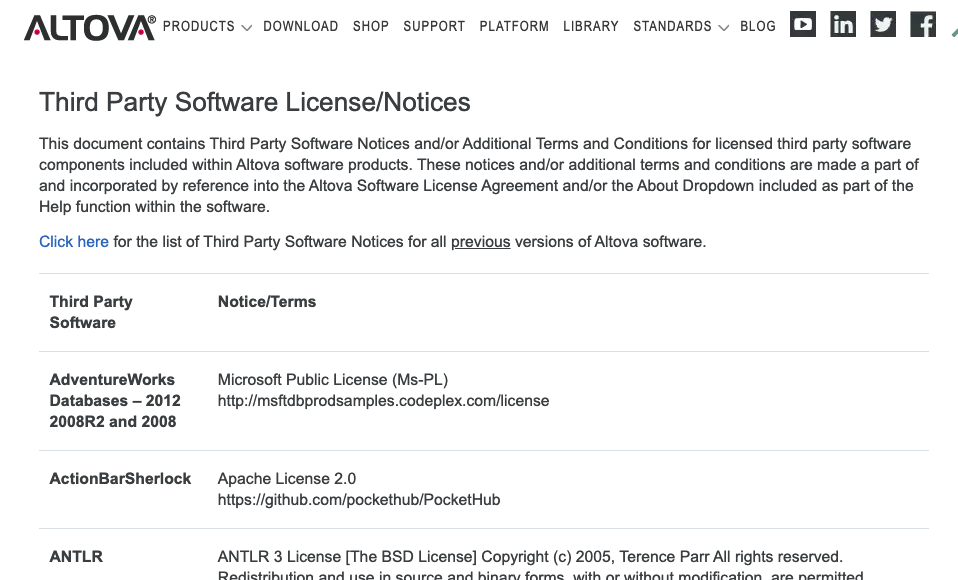
SBOM is an acronym that means Software Bill Of Materials. The concept originates from the manufacturing industry, where a bill of materials lists dependent components in machinery. A SBOM lists all third-party components present in your application. A good SBOM also lists the licences used by each component and, when possible, the specific copyright attribution. An excellent SBOM can also provide further information, such as possible relationships between those components to better understand any supply chain risk. You may have encountered SBOMs in the past, known as “third party notice” documents created to manage legal requirements, such as the one in the image below. 

Altova Third Party Software License Notice

However, modern SBOMs are “machine-readable”.  They follow a strict specification that can be understood by a computer. 

What machine-readable formats are used to publish SBOMs?

The most commonly used formats to define a SBOM are:

  • CycloneDX, a lightweight open-source standard designed for use in application security context and supply chain component analysis. This originated from within the OWASP community.
  • SPDX, an open source format with origins in the Linux Foundation, slightly more complex, and recently approved as ISO/IEC standard in version 2.2.1 as ISO IEC 5962:2021.
  • SWID, another ISO/IEC industry standard used by various commercial software publishers.

All these formats support a variety of use cases, but the first two (CycloneDX and SPDX) are the most versatile. Due to SPDX’s complexity, we think CycloneDX has an edge at this time, but only time can tell which of these formats will be the winner. To learn more about these formats you can also read the official NTIA publication, which drills down into the matter.

Why are SBOMs important? And how are they useful?

As a consumer of software, the main reason why you want to have access to the SBOMs of the systems you are using is to manage risks. When a very commonly used software component becomes vulnerable: how do you know what you need to patch and which subsystems are at risk? This is exactly what happened with the recent Log4Shell debacle. The logging library called Log4j, was suddenly exploitable with a very simple and repeatable attack. How do you know where it is? Which one of the systems you are using is suddenly at risk?  With a correctly managed archive of SBOMs, getting this information reduces to a very simple lookup task. Without it, it can be a real nuisance —a time consuming information hunt that disrupts everyone’s work flow.

As a producer of software, instead, you want to preserve and maintain an archive of all the SBOMs of the system you produce so that you can create and distribute timely patches to your customers. Having a systematic and comprehensive analysis of your most commonly used software packages would be useful indeed. Some companies were very fast in releasing patches to their customers, while others were extremely slow, mostly because they did not have the information.  You probably want to be in the first group of companies 🙂

Governments are also mandating the need for use of SBOMs, realising that software security needs to be regulated.  The U.S. Executive Order 14028 that mandates all federal agencies to require SBOMs from their suppliers.  This not only impacts the companies that have direct sales to the US government but also their own software suppliers.  As so many systems and devices have been connecting to the Internet to send and receive information, consequently our digital world relies on a software supply chain.  This “ripple effect” will be significant for many industries. 

It’s important to consider how software products you produce can meet basic security requirements and how the associated software security information is produced and managed in your organisation.   Similar legislation has already been proposed in Europe since the publication of  “Guidelines for securing the IoT” by ENISA (hint: SBOMs are required) and the ETSI EN 303 645 global standard for consumer IoT security, which is based on the UK government’s Code of Practice.  See also the recently published Product Security and Telecommunications Infrastructure (PSTI) Bill and more to come from the UK government to improve the UK’s cyber resilience.

How should SBOMs be handled?

Very carefully :), because an SBOM contains the full list of the “ingredients” of your system or application. While open-source projects happily share this information to the world, the same does not apply to private companies. In fact, a malicious actor that gets hold of the SBOM of your system can then check if you are using any vulnerable components. There are public vulnerability databases, such as the NVD, which are very popular. Someone can simply browse in there and compose a list of possible attacks, try them, and maybe get lucky.  Probably 9 out of 10 vulnerabilities affecting components in your system won’t be exploitable, but having the ability to go through the whole list, certainly makes the task of finding an exploit much easier. 

There’s no need to keep SBOMs a complete secret, however, as long as a few simple principles are kept in check:

  • SBOMs need to be shared securely,
  • they need to be accessed only by the authorised parties, across organisational boundaries, and
  • they should not be tampered with.

In summary, it is essential to produce a precise SBOM, and it is just as vital to share it and maintain it securely with the correct (trusted) third parties.  

Why bother with SBOMs now?

In summary, it is essential to produce a precise SBOM, and it is just as vital to share it and maintain it securely with the correct (trusted) third parties.  In our hyper connected world, comprehensive coverage of components is important for preventative strategies and threat detection in supply chain attacks.  Therefore, implementing SBOM management proactively now will be worth something to your organisation when the next critical vulnerability appears and stand your organisation in good stead. All good collections are worth organising. How valuable is your collection of software?

Photo by Susan Q Yin on Unsplash

Get started with SBOMs

The need for SBOMs is already high. Level up your open source software security and implement this requirement. Check out the SBOM capabilities in Meterian-X platform’s approach to DevSecOps.

An introduction to the world of SBOMs