Great news for all you mobile developers out there! Meterian, a leading Software Composition Analysis (SCA) platform, has just rolled out support for Dart, the programming language that’s become super popular for building Flutter apps. If you’re crafting mobile apps with Flutter, this update is specially tailored for you. Let’s dive into what this means and why it’s a game changer for Flutter developers.
Why Dart and Flutter are a big Deal
Developed by Google, Dart is all about building smooth and stunning mobile and web applications, and it’s the powerhouse behind Flutter—Google’s UI toolkit for crafting beautiful, natively compiled applications from a single codebase. Flutter’s ability to deliver apps that feel great on both Android and iOS has made it a hot favorite. With Dart now getting the spotlight it deserves, security and efficiency in app development are set to reach new heights.
Meterian embraces Dart
With Dart on its radar, Meterian is making sure that your development toolkit is not just powerful but also secure. This inclusion means Meterian can now safeguard your Flutter projects right from the get-go, catching potential security slip-ups before they become real headaches.
Meterian’s leap to include Dart is more than just an update—it’s setting a new standard for mobile app security. By embracing the needs of the Flutter community, Meterian is not only beefing up the security of apps but is also paving the way for projects that scale smoothly and stay robust under pressure.
What’s in it for Flutter developers?
We believe Flutter will eventually get a dominant position in the mobile development scene, so it’s essential to have tools that ensure that your applications are rock-solid safe. Meterian’s support for Dart brings you a suite of benefits:
Boosted Security: Spot vulnerabilities early in the development cycle with Meterian’s SCA tools, keeping your apps safe from security threats.
Stay on the Right Side of Compliance: Keep up with the latest security standards easily, ensuring your app complies with legal and regulatory requirements.
Seamless Development Flow: Meterian fits right into your existing workflows, helping you patch up security issues without slowing you down.
Scale with Confidence: As your app grows, Meterian grows with it, making sure that even the most complex projects stay manageable and secure.
With Dart in Meterian’s toolkit, it’s an exciting time to be building apps with Flutter. This move shows Meterian’s commitment to supporting the latest and greatest in app development, making it easier for you to build apps that aren’t just awesome but are also secure and compliant. To learn more about Meterian’s support for Dart/Flutter and how it can help improve the security of your projects, visit Meterian’s website at www.meterian.io.
In the digital age, healthcare companies are guardians of vast amounts of sensitive user data, ranging from personal health records to financial information. With this responsibility comes the challenge of ensuring data integrity and security against the growing threats of cyberattacks and data breaches. Meterian, a leader in application security, is at the forefront of providing solutions that safeguard this critical data.
Healthcare providers harnessing open-source software face unique security risks that require vigilant management and protection strategies. Meterian’s innovative tools actively scan and identify vulnerabilities within applications, ensuring that all components are up to date and secure against potential threats. By leveraging Meterian’s capabilities, healthcare companies can not only protect their patient data but also enhance their overall cybersecurity posture.
Protecting patient records.
In collaboration with Emis Group, a well-established brand in healthcare technology, Meterian has demonstrated its value in real-world applications. Emis has utilised Meterian’s solutions to bolster their applications’ defences, thereby protecting millions of patient records. While our partnership with Emis illustrates Meterian’s capability to handle the complex cybersecurity needs of large enterprises, it’s important to recognise that our solutions are equally effective and accessible for SMEs and startups. Meterian understands the unique challenges faced by smaller organisations, including tighter budgets and limited resources, as our platform is designed to be flexible and scalable.
For healthcare organisations, the fear of missing out on the highest level of security should be a significant concern. Meterian provides an essential layer of security that automates and streamlines the detection and management of vulnerabilities—tasks that would otherwise consume valuable development resources. As legislation evolves and compliance becomes even more stringent, Meterian’s tools help healthcare companies stay ahead, ensuring they meet all regulatory requirements while securing user data against emerging threats.
A successful case study.
To see first – hand how Meterian is enhancing cybersecurity in the healthcare industry, we invite you to explore our success story with Emis Group. This case study provides a detailed look at how Emis leveraged Meterian’s cutting-edge solutions to fortify their application security, ensuring compliance with stringent regulations and protecting sensitive patient data.
The UK government’s flagship cyber security event, CyberUK 2024. is just around the corner! Hosted by the National Cyber Security Centre (NCSC), this annual gathering brings together over 2,000 cyber security leaders and professionals for networking, knowledge exchange, and collaboration.
We will be exhibiting at CyberUK 2024. Loved by SMEs and CNI, our secure-by-design agile approach to software development delights developers and compliance teams. Come and learn how Meterian protects the Open Source Software Supply Chain.
Visit us Stand IZ3 at the Birmingham ICC, May 13-15th.
The open-source software (OSS) ecosystem thrives on the principles of transparency and collaborative development. However, a recent critical vulnerability discovered in the core library, liblzma, has cast a shadow on this trust. The vulnerability, which was disguised as a bug fix, contained malicious code that could have potentially granted attackers access to users’ systems through SSH servers. This unsettling incident serves as a sobering reminder of the tangible risks inherent in relying on third-party software packages, even within the seemingly open and collaborative realm of OSS.
What happened?
liblzma, a critical library used for compression in many Linux distributions, was compromised by a backdoor hidden within its source code. This backdoor, attributed to a contributor named Jia T75, remained undetected for two years. During the build process, the backdoor would infect the system, specifically targeting x86_64 Linux systems. This vulnerability could have allowed attackers to compromise SSH servers, potentially granting them unauthorized access to a user’s system.
Why third-party packages are a risk
While OSS thrives on collaboration, it also introduces vulnerabilities. We rely on the good faith of developers contributing code. Malicious actors can exploit this trust by injecting backdoors or other harmful code into seemingly legitimate libraries like liblzma.
What can you Do?
To mitigate the risks associated with third-party software packages, it is imperative to stay vigilant and proactive. Patching software promptly by updating your system regularly ensures you have the latest security fixes in place. Furthermore, exercising caution when obtaining software updates and packages by exclusively utilizing official or trusted sources is of utmost importance. Thoroughly researching the maintainers of the software packages you rely upon can shed light on their track record of responsible updates and reputation within the community. Whenever feasible, exploring alternatives to widely used libraries can be a prudent strategy, as diversifying your software portfolio can reduce the potential impact of a single vulnerability. By adopting these measures, you can bolster the security posture of your systems and minimize the risks posed by third-party software dependencies.
How Meterian can help
The liblzma backdoor incident serves as a wake-up call, and it highlights the need for constant vigilance. By understanding the risks and taking preventative measures, we can build a more secure software ecosystem. Remember, security is an ongoing process, not a one-time fix .
Security solutions like Meterian can be powerful allies in mitigating the risks of third-party packages. Meterian’s notification system keeps you informed about the latest vulnerabilities impacting your software ecosystem, including critical flaws like the recently discovered liblzma backdoor. Through timely alerts and detailed reporting, Meterian ensures you stay on top of potential threats before they can be exploited]. Additionally, Meterian’s Software Composition Analysis (SCA) solution goes a step further by scanning your codebase for known vulnerabilities within dependencies like liblzma. By proactively identifying these risks, SCA allows you to take early action and prioritize patching vulnerable components, ultimately safeguarding your systems and data.
Don’t wait for the next major vulnerability to compromise your systems. Take control of your software security today. Try Meterian for free and experience the power of proactive vulnerability detection and management.
An important note!
The xz/liblzma packages are sometimes included in major Linux distributions, and much of the focus is now there, also because this vulnerability can be exploited to execute remote commands over SSH. However, please be aware that this vulnerability may affect also your application code, either because it may be linking directly liblzma in your C/C++ applications or because, via conan, you previously used the package xz_utils in one of the vulnerable versions (5.6.0, 5.6.1). Furthermore, other wrappers such as xz.ex (elixir), xz.net (dotnet), ruby-xz (ruby) and similar packages may indirectly pull the affected package.
Update – 15 April 2024
This is a novel situation, and there is still much uncertainty. We are aware of only a single known exploit path at this time, but there may be additional scenarios that have not yet been identified.
In detail, so far, it looks like the payload activates if the running program has the process name /usr/sbin/sshd, however, based on ongoing analysis, it may activate also in other scenarios too, unrelated to SSH. This matter is still investigated, you can keep an eye at this page to follow the active investigation.
The European Union Cyber Resilience Act (CRA), which was proposed on September 15, 2022, is the first EU-wide legislation addressing cybersecurity requirements for software and hardware manufacturers. Unlike the U.S. Executive Order, the CRA extends to all vendors who create products with digital components that connect to the internet. It will become enforceable in early 2027, three years after its ratification.
SBOM Requirements of the CRA
One of its key requirements focuses on Software Bill of Materials (SBOMs). An SBOM is essentially a comprehensive inventory of all software components used in a product. It provides transparency by listing out the dependencies, libraries, and third-party code that make up a software application. Think of it as a “recipe” for your software – it tells you exactly what ingredients (components) are included.
The key points related to Software Bill of Materials (SBOM) requirements under the EU Cyber Resilience Act are:
Manufacturers must identify and document product components and vulnerabilities, including the creation of a SBOM of at least the top-level dependencies of the product
The SBOM does not have to be made publicly available
The SBOM should be included in the technical documentation and, upon request, provided to market surveillance authorities
The EU Cyber Resilience Act mandates SBOM adoption to enhance cybersecurity and ensure transparency in software and hardware supply chains. Manufacturers need to create SBOMs for their products, while public availability is not required.
Why SBOMs are essential
SBOMs are a sensible tool to manage your supply chain transparency. With the increasing complexity of software supply chains, understanding what goes into your product is crucial. SBOMs allow manufacturers to trace the origins of each component, identify vulnerabilities, and assess risks.
By having an SBOM, organisations can proactively address security vulnerabilities. When a known vulnerability is discovered in a library or component, manufacturers can quickly assess which products are affected and take necessary remediation steps.
They are also required for compliance and legal requirements. Specifically, the CRA mandates that manufacturers create SBOMs for their products. Compliance ensures that products meet cybersecurity standards and reduces legal risks.
Why SBOMs are complicated
Creating and maintaining Software Bill of Materials (SBOMs) is a time-consuming process due to the intricate nature of modern software. Applications are no longer simple; they consist of interconnected components, libraries, and dependencies. The prevalence of open-source software further complicates matters. Each component introduces its own set of dependencies, licences, and potential vulnerabilities. Identifying and tracking all these elements manually is a daunting task. Ensuring accuracy, compliance, and security within this complex landscape inevitably consumes significant time and effort.
That’s the reason why it’s a good idea to adopt an automated solution that takes this problem away.
Meterian: your automated SBOM solution
Using automated analysis, Meterian continuously scans your codebase, identifies the whole network of dependencies, and generates an SBOM automatically. No manual effort required, as SBOMS can be created and stored during the analysis, or later on demand. This will save a substantial amount of time to your developers, who can say goodbye to weeks of research at each release. Everything happens directly on your pipelines or at the touch of a button.
With the help of his powerful vulnerability scanner, Meterian provides you all relevant vulnerability Insights. The Meterian vulnerability database tracks more than 340k vulnerabilities across more than 20 different OSINT sources. You will also automatically receive real-time alerts about vulnerabilities in your components, even if you do not actively analyse them: Meterian will do it for you.
Meterian is easy to integrate in your processes, as it seamlessly integrates with your development pipelines, ensuring continuous monitoring without any extra activity. A simple click, some lines of YAML, one or two lines of script, is all it takes. You get protection against vulnerabilities and compliance at the same time, without any extra effort.
Conclusion
As the EU Cyber Resilience Act comes into effect, manufacturers are required to embrace SBOMs to ensure transparency, enhance risk management, and achieve compliance. The Meterian platform simplifies the generation of SBOMs, enabling you to concentrate on developing secure and resilient software.
Remember: An SBOM isn’t just a regulatory requirement; it’s a powerful tool for safeguarding your digital products. Start creating your SBOMs today!
The events of the last few years have highlighted the world’s vulnerabilities and shown the importance of building resilience into organisations, supply chains and the global economy. COVID-19 and the war in Ukraine have exposed issues we’d chosen to ignore, thought we’d fixed forever or hadn’t even considered before. Growth is no longer guaranteed. The global economy’s increasing reliance on technology to enable the world to function extends the attack surface and opens up new cyber security threats.
The need for cyber security to protect sustainable growth
Governments are struggling with plans for sustainable economic growth against a background of conflict, continuing supply chain problems, climate change, rising prices and interest rate increases. Typical sustainable development goals include; economic growth measured by GDP; business innovation and infrastructure renewal; creating sustainable cities and communities; and responsible consumption of products.
From smart cities, to renewable energy, financial infrastructures and driverless transport, cutting-edge technology is at the heart of our drive for sustainable growth. This provides exciting opportunities but has also exposed existing systems’ weaknesses and created new vulnerabilities to malicious actors. Sustainable development goals are all put at risk by the increased threat from cyber attacks.
Organisations have become familiar with safety and security measures which protect their physical environment such as installing early warning sensors, security cameras, fire safety equipment and intruder alarms. There’s a need for a cultural shift for executives, investors, employees and regulators to recognise the increasing importance of cyber security. The war in Ukraine has brought into sharp relief the importance of having both strong physical and cyber defences. Cyber resilience is absolutely necessary for modern civilisation to survive and flourish.
How big is the cyber threat?
Recent research and headlines point to cyber crime being very big business indeed. One study showed cyber criminals raking in $1.5 trillion every year. To put that in context that’s exactly the same amount proposed for the US Congress’ bipartisan package to help Ukraine and finance federal agencies for the second half of 2022. Another study from Cybersecurity Ventures expects global cybercrime costs to reach $10.5 trillion annually by 2025. This led Steve Morgan, Editor-in-Chief at Cybercrime Magazine to comment, “This represents the greatest transfer of economic wealth in history, risks the incentives for innovation and investment, is exponentially larger than the damage inflicted from natural disasters in a year, and will be more profitable than the global trade of all major illegal drugs combined.”
Innovation is a growing target for cyber criminals
Innovation and invention are seen as good things for businesses and the wider economy. They power economic growth and prosperity around the world but by their very nature they can open the door to cyber criminals. Innovation is all about new technologies, products and ways of working. The cloud gaming sector is a prime example of an industry that has attracted the attentions of hackers, due to its constant growth, developing new platforms and introducing new products almost daily. As the industry transitions to cloud infrastructures, the market size was estimated at $609.67 million in 2021, and is expected to grow to $7.382 billion by the end of 2028 according to research by Brandessence. Change, as in this case, often comes at dizzying speed. This means that procedures, controls, security and monitoring may lag behind. Ripping up the rule book to innovate can have huge positives but organisations need to watch for the negatives too. Indeed, some of the largest cyber security incidents in 2022 were targeted at the gaming sector, with breaches reported by such behemoths as Rockstar, Roblox and NVIDIA, to name just a few.
Rapidly expanding sectors and businesses naturally also attract huge investment. This makes them even more attractive for wily cyber criminals as the rewards from attacks can be particularly lucrative. Another pertinent example is the renewable energy sector. This growing industry promises great things for our hopes of preserving the world we live in. Massive investment means it is also shaping up to be a very attractive market for cyber criminals.
Jim Guinn, global managing director for cyber security in energy, chemicals, utilities and mining at Accenture has noted, “The cybersecurity conversation in the renewable energy engineering and construction business is almost nonexistent today.” It is imperative that such industries underpin their expansion with the appropriate focus on defence against cyber attacks.
Protecting your software stack
The way today’s technology solutions are created using a jigsaw puzzle of multiple pieces including published APIs, integration with proprietary products, cloud applications from different vendors, open source components all combined with in-house developments means that many organisations are unsure about their complete Software Bills of Materials (SBOMs). This means vulnerabilities are literally built into critical systems introducing undocumented threat vectors which can be used by hackers to gain access to proprietary systems and data.
This lack of knowledge about an organisation’s SBOMs means that even when a bug or vulnerability is identified in the open source community and patches created, the business can be completely unaware of the fact that it needs to take remedial action. There are many examples of this type of oversight resulting in huge costs and disruption for business.
Secure by default – building resilience
In 2023, developers and publishers of software must focus on Secure by Default principles if systems are to avoid the kind of failures due to poor security posture and an over reliance on end-users to act in a secure manner. The user experience is an integral part of the security features of a system, because if security makes software inconvenient to use, end-users will simply find a workaround. If security isn’t second nature then it’s no security at all. The UK Government has introduced tough new regulations in the Telecommunications (Security) Act which includes the requirement to have a deep understanding of security risks, including those within the supply chain. This builds on the premise that ‘edge’ devices such as radio masts, internet equipment, or wifi routers supplied to customers should be protected from cyber attack.
NCSC Technical Director Dr Ian Levy made the point: “We increasingly rely on our telecoms networks for our daily lives, our economy and the essential services we all use. These new regulations will ensure that the security and resilience of those networks, and the equipment that underpins them, is appropriate for the future.”
Online risks spill over into the physical world
Increasingly, online services are impacting people in the real world. A high profile example is the fall out from the 2017 Equifax data breach, which it is estimated to have cost the company at least $1.38 billion, with some sources suggesting the final bill could be closer to $2 billion. The root cause of the data breach was the failure to patch a known open source web application security flaw. This left the cyber doorway open for criminals to enter and cause havoc. Over 140 million U.S. consumers’ data was affected, putting them at risk of future financial instability—being unable to rent housing, being denied a loan, having to pay higher interest rates on credit cards or mortgages, and greater difficulty in getting a job, not to mention the distress and anxiety identity theft causes.
A more recent example, described as the biggest hack in history that affected telco Optus, led to one in three Australians at risk of identity theft or fraud. As a result, 10,000 victims have had their personal details published online and millions of people are scrambling to change their online driving licenses. T-Mobile data breach that affected 37 million accounts was detected in January 2023 but the weakness in the API had been exploited since November 2022.
Automating Development & Security Operations (DevSecOps)
As software development accelerates and the attacks of malicious actors continue to increase in speed and intensity, organisations must ensure their security operations are equipped to respond equally fast. Preventative strategies can be built into the development workflow to ensure that DevSecOps processes are efficient and maintain the appropriate vigilance without wasting human resources. Such processes become operationally effective if for every critical patch released, the security and development teams are ready with normal business practice to identify the threat, confirm its presence in their application software estate and remediate as quickly as possible as part of business as usual. Without DevSecOps, such operations can take days to weeks, but forward thinking teams will have worked this out so such incidents take minutes to hours, thus preventing unauthorised access or infiltration of malware via an open source vulnerability.
With some 64% of companies impacted in 2021 by supply chain attacks, mostly due to increased reliance on open source software components, organisations must be scrupulous about checking that underlying dependencies are safe from vulnerabilities. A further study showed such attacks were up 300% compared to the preceding year. Businesses that prepare thoroughly against such risks will be well rewarded. Not only are they underpinning their own operations, ensuring that their business can continue to grow and innovate without hindrance from malicious attacks, they protect their reputation by providing reliable products and services to their customers. In turn, customers know that they can trust their supplier, building loyalty in the business that transcends a purely transactional relationship.
Ensuring that technology works as it should has long been a given. Now it is an expectation that tech works securely, protecting personally identifiable information, while still providing a great user experience, so that people can get on with their lives, knowing that their trusted suppliers are looking after their data securely. It is a challenge for the entire technology industry, but one on which our very way of life depends.
Visit www.meterian.io to learn how Meterian can help secure your businesses’ open source components to reduce the threats of cyber attacks.
Managing the technology stack and known vulnerabilities is becoming a key criteria for cyber insurance pay outs
Open source software has once again made the headlines following warnings to organisations about the release of a new version of OpenSSL. Released on 1st November 2022, the new version patched vulnerabilities in version 3.0 and above of the nearly ubiquitously used cryptographic library for encrypting communications on the Internet.
The OpenSSL Project team took the unusual step of pre-warning organisations five days ahead of the 1st November release date that a critical update was being issued to address the vulnerabilities. This came as a surprise to many as the OpenSSL library rarely has critical vulnerabilities, but due to its popularity and widespread use, organisations were advised to be cautious and to prepare.
Based on the assessment by the OpenSSL team, the vulnerabilities can be exploited and trigger data leakage or remote code execution. It is hard to predict the potential damage and risk of these vulnerabilities, which is why it’s vital for organisations to act swiftly, determine any use of the affected OpenSSL and patch immediately if they are exposed to the vulnerabilities. However, as these vulnerabilities were classified as “high severity” and not critical as initially thought, widespread exploitation is not expected.
Open Source the foundation of modern software
The benefits of open source software are numerous and well known, so let’s be clear open source is not the problem – our ability to learn from the past is.
There have been a couple of big open source incidents in the last year that have sent shock waves through the cyber security world. Firstly, the vulnerability in the widely deployed Log4J component, and now this new vulnerability in OpenSSL. This is only the second such flaw ever found in the open source encryption project. The first was Heartbleed.
The December 2021 zero-day vulnerability in the Java logger Log4J, known as Log4Shell, was characterised by many security experts as the single biggest, most critical vulnerability of the last decade. If left unpatched, attackers can hack into systems, steal passwords and logins, extract data, and infect networks with malicious software causing untold damage, not least to brand reputations.
Unfortunately, a situation that specialty insurer Crum & Forster, owned by Fairfax, know all too well after falling victim to the hacking group known as RansomHouse. Despite widespread news coverage of the Log4shell vulnerability, which was revealed in December 2021, it appears the insurer was still vulnerable.
The breach at Crum & Forster was first discovered on 22nd July 2022. The hacking group were able to exploit an unpatched system, resulting in a total of 1.7 gigabytes of sensitive data being released, including medical information, insurance policies, employee data, and customer lists.
Crum & Forster are by no means an isolated case, there are many examples over the years of companies falling victim to known vulnerabilities.
History repeating itself
The Heartbleed vulnerability, discovered in 2014, impacted hundreds of thousands of web and email servers worldwide. Among the many systems confirmed to be affected were large organisations such as Yahoo, Eventbrite, and even the FBI’s own website. Many of the big companies confirmed to be affected were able to get their ducks in a row and patch before anything severe happened.
Others weren’t so quick off the mark and hackers were able to exploit the vulnerability in several cases. The Canadian Revenue Agency was one of the many victims that suffered a breach as hackers exploited the Heartbleed vulnerability. The breach resulted in the theft of hundreds of social ID numbers in a six-hour period before the Canadian Revenue Agency realised and removed public access to its online services.
In the aftermath of a breach, companies are quick to express that lessons will be learnt. Unfortunately, in a case of history repeating itself, the Canadian Revenue Agency was once again hitting the headlines. In 2017, just 3 years after Heartbleed, the company had to shut down its website for filing federal taxes due to falling victim to the open source Apache Struts2 vulnerability.
Fail to patch, plan to fail
Several years on from when Heartbleed was discovered and a patch issued, there are still servers harbouring the Heartbleed vulnerability. In November 2020, a security researcher at the SANS Internet Storms Centre discovered that over 200,00 machines are still vulnerable to Heartbleed. The news cycle may have moved on but that doesn’t mean unpatched vulnerabilities have disappeared.
Too many headlines are showing that hacks have one thing in common, they are caused by a known vulnerability within an open source component.
A well know example is the Equifax data breach in 2017, which remains one of the largest cybercrimes related to identity theft. The private records of 147.9 million Americans along with 15.2 million British citizens and approximately 19,000 Canadian citizens were compromised in the breach.
A key security patch for open source software Apache Struts was released by the Apache Software Foundation on 7 March 2017 after a security exploit was found. All users of the framework were urged to patch immediately.
For one reason or another, the patching process within Equifax completely broke down, resulting in vulnerable systems being left open to compromise. Subsequent scans conducted by the Equifax IT department to identify any vulnerable systems appears to have failed and, as the saying goes, the rest is history.
The cost of downplaying security
Recent estimates suggest the 2017 Equifax data breach cost the company at least $1.38 billion, with some sources suggesting the final bill could be closer to $2 billion. The root cause of the data breach was the failure to patch a known open-source web application security flaw. The company effectively left the door open for cyber criminals to walk in and wreak havoc.
In the aftermath of the breach Equifax was condemned for its lax security posture, shambolic emergency response and poor leadership, which led to many senior executives being accused of corruption. The Equifax breach investigation highlighted several security lapses that allowed attackers to enter, allegedly secure, systems and exfiltrate terabytes of data.
More than five years on, the Equifax data breach remains a cautionary tale in failing to manage cyber security risk effectively and lacking the tools and processes to implement a robust vulnerability and patch management regime.
Cybercrime has become a highly lucrative operation; it is not going away and is only set to worsen as companies continue to engage digital technology. Many have taken out cyber insurance to insulate themselves from the punishing costs of cyber-attacks and data breaches.
However, companies across the world are likely to face increases in the cost of insurance as the number of claims increase year on year. According to research conducted by FitchRatings, US claims volume has risen 100 percent annually over the past three years.
In part as a result, the cost of cyber insurance has risen steeply in 2022 in both the US and the UK. According to Marsh, the UK cyber insurance market experienced a pricing increase of 102% year-over-year in the first quarter of 2022.
As a result of rising claim costs, the insurance industry is tightening their qualifying requirements and limiting their coverage. Cyber insurers now require organisations to provide information about their security controls if they want coverage. This can include technical, procedural, and human controls.
Keeping track of your open source exposure
Software Bill of Materials (SBoMs) are an emerging approach to keeping track of your software dependencies, both open source and commercial. SBOMs provide the ingredients list to understanding what code exists within the applications that your business relies upon.
Only by understanding what exists inside applications can organisations evaluate their exposure to risk. Used effectively, SBOMs enable companies to evaluate and target remediation efforts. But most importantly, companies won’t be blindsided when the next big open source vulnerability is announced.
Known vulnerabilities are your responsibility
Many cyber insurers have tightened their standards and are no longer paying out for breaches that have resulted from a known vulnerability. This should serve as a sharp wakeup call to boardrooms that deploy technology, with little thought to the security implications. If companies want to ensure they continue to receive all the benefits of their policy, it’s vital that they have a rigorous patch management system. Corporates may have short memories when it comes to known vulnerabilities but, as the evidence shows, cyber criminals do not.
Companies must increase visibility and transparency of the components in their open-source software and applications if they are to stay one step ahead of cyber criminals. Without continuous management of your governance, risk, and compliance of open source your company is walking a tight rope, without a safety net. Those that fail to learn from history are doomed to repeat it.
The breaking news in December 2021 of the zero-day vulnerability in the Java logger Log4j 2, known as Log4Shell, sent shockwaves through organisations around the world. Over the last 20 years Log4j has been used globally in billions of software developments and applications for logging incidents. This meant that until the vulnerability could be mitigated, the doors were open to millions of organisations. Attackers could break into systems, steal passwords and logins, extract data, and infect networks with malicious software causing untold damage. The issue was also a major threat to corporate reputations, especially where trust and confidentiality was key, such as in the financial services sector.
In the early hours an alert notification about the Log4j critical vulnerability reached one major financial services organisation based in the UK, with Fortune 500 clients around the world. On hearing the news, the Director of DevOps and Engineering cross-checked other sources for corroboration, including social media, and contacted the organisation’s Lead Technical Security Officer. It was clear that, unchecked, this could be a major problem, but how big an issue would depend on how widely Log4j 2 was embedded into systems used and being developed throughout the corporation.
Often in the race to innovate and implement systems quickly, documentation may not be as comprehensively kept and updated as ideally required. In its absence, it can be difficult for an organisation to discover how widely Log4j is integrated within its application estate, let alone know if it has been previously patched.
The race was on against the malicious actors poised to automate exploitation of Log4J vulnerabilities, with major impacts for the corporation and potentially for millions of customers around the world.
Mobilising the IT & Security Workforce with Meterian
The organisation moved rapidly by using Meterian’s out-of-the-box reports to enable it to identify where Log4J vulnerabilities were to be found across its application estate, and hence the size of the potential problem. Only then could it be possible to build a remediation plan to mitigate the risks of all the Log4J vulnerabilities.
By 10am, the list of projects utilising the Meterian solution could be seen via the Meterian Dashboard and automated scanning initiated. Scanning the software bills of materials of the affected projects, an indication of the potential impact of Log4J was emerging which could give direction and scope on the follow-up actions. Other projects which had not yet begun to use Meterian as part of their regular processes, found that Meterian’s simplicity of use meant that they could also quickly scan their projects for vulnerabilities.
Working methodically and forensically with the organisation’s development teams across multiple locations, by 5pm it was possible to present to senior management a concise summary of the situation, showing areas of the business at risk; those projects which had already been remediated; and those still needing work. A comprehensive communication plan was then invoked to alert the business to remaining vulnerabilities.
The following Meterian tools were used:
Meterian Sentinel notification alerts: an always-on security messaging service which sends notification alerts, emails, or Slack IMs to account administrators about new public vulnerabilities found in open source components used by their projects.
Meterian Boost Open Source Security (BOSS) Scanner: which gives instant visibility to the application’s open source dependencies with automated discovery, risk scoring, continuous scanning, and actionable security insights.
Meterian Account Dashboard: insight reports show dependent components and related Critical/High/Medium/Low vulnerabilities within the remit of a particular account.
The Meterian toolset alerts key employees to security issues and vulnerabilities; the breadth of the issue for the organisation’s application estate; and the projects impacted. The CISO is then armed with all the information needed to mobilise an effective action plan and comprehensive remediation.
Visibility and Control of Vulnerable Components
Log4J created great upheaval in IT teams across the industry, but for this business unit at this global Financial Services organisation, Meterian tools rapidly delivered a complete view of projects that were susceptible to attack. In comparison, other business units were not able to gather such insights so quickly because there was no single comprehensive reference point which was easy to access and use.
Meterian enabled a speedy time to resolution: 2 hours to implement remediation on projects identified using Meterian as having the Log4J vulnerability.
Meterian freed up employee time from finding the vulnerabilities, enabling them to focus on isolating the application estate from risk and implementing remediations. The Log4J threat demonstrated that critical incident prevention is possible with a more automated, secure-by-design approach. Additional or external staff were not required as existing employees could use smart tools on their application estate, and on a more regular basis to save time and remove headaches.
Through using Meterian the organisation benefits from:
Prompt alerts and early warnings of vulnerabilities in the open source software supply chain
Enhanced protection against threats
Increased confidence in people and tools working together to protect from organisational risk
Decreased stress that vulnerabilities will cause major damage and reputational harm
Reduction in “known unknown” risks and number of security fires
Cultivating Cyber Resilience Consistently and Responsively
The organisation is using the effective response enabled by Meterian as a case study to demonstrate that regulatory and compliance requirements can be met with easy-to-use continuous scanning tools that provide immediate visibility and quicken the development of secure code.
The proven partnership with Meterian will extend and facilitate their further innovation in automation, analytics and cyberresilience, through even more responsive and secure development.
Visit our homepage to learn more about how Meterian can secure your businesses’ open source components—keeping cyber hackers out and your intellectual property in.
Recent high profile cyber security incidents have reinforced the importance of cleaning up the open-source software supply chain. From Heartbleed to the Apache Software Foundation’s Log4j vulnerability, these highly publicised incidents have exposed the threats associated with the software supply chain.
Open source security vulnerabilities are nothing new. Heartbleed was a security bug in the OpenSSL cryptography library that affected many systems. Similarly, Log4Shell is a severe vulnerability, however in the case of Log4j the number of affected systems could well run into potentially billions. Many cybersecurity experts have characterised Log4Shell as the single biggest, most critical vulnerability of the last decade.
These incidents have brought into sharp focus the risks and galvanised a range of responses at national and international level. It even prompted the White House to convene an Open Source Software Security Summit in January that was attended by leaders from global technology companies including Google, Meta, Apple, and Cisco. Members of the open source community were also represented at the summit, as well as US government agencies, including the Cybersecurity and Infrastructure Security Agency, the National Security Council and the National Institute of Standards and Technology.
The gathering may have been precipitated by the Log4Shell vulnerability, but the wider context was clear. How do we ensure source code, build, and distribution integrity to achieve effective open source security management?
Open source under the microscope
Technology companies have been using open source for years as it speeds up innovation and time to market. Indeed, most major software developments include open source software – including software used by the national security community.
Open source software brings unique value, but it also has unique security challenges. It is used extensively, however, the responsibility of ongoing security maintenance is carried out by a community of dedicated volunteers. These security incidents have demonstrated that the use of open source is so ubiquitous that no company can blindly continue in the mode of business as usual. Recent research showed that 73% of applications scanned have at least one vulnerability[1]. These can be buried deep in the open source software supply chain that software-driven businesses rely on for basic functionality and security to accelerate their time to market.
The known unknown
The concept of known knowns, known unknowns and unknown unknowns has been widely used as a risk assessment methodology. When it comes to cybersecurity and the voracity of threat actors to exploit vulnerabilities, it is a useful analogy.
Let’s take Apache Log4J as an example. Companies often create products by assembling open source and commercial software components. Almost all software will have some form of ability to journal activity and Log4j is a very common component used for this.
How do you quickly patch what you don’t know you have?
Java logger Log4j 2 – A zero-day vulnerability
Log4J was originally released in 2001, and over the last 20 years it has been used in billions of software developments and applications across the world. For logging incidents within software, Log4j is used by everything from the humble 404 error message, gaming software such as Minecraft, and Cloud providers such as iCloud and Amazon Web Services, as well as for all manner of software and security tools.2 On 9 December 2021, the zero-day vulnerability in the Java logger Log4j 2, known as Log4Shell, sent shockwaves across organisations as security teams scrambled to patch the flaw. If left unfixed, attackers can break into systems, steal passwords and logins, extract data, and infect networks with malicious software causing untold damage, not least to brand reputations.
However, herein lies the problem. How do you quickly patch what you don’t know you have?
Often in the race to innovate, the first thing sacrificed is up-to-date documentation. Without it how does a company know if Log4J is integrated within its application estate, let alone know if it has been previously patched.
Improving safety and trust when speed is of the essence
If we are to increase safety and trust in software, we must improve transparency and visibility across the entire software supply chain. Companies should have the ability to automatically identify open source components in order to monitor and manage security risk from publicly disclosed vulnerabilities. A software bill of materials (SBOM) should be a minimum for any project or development. Without such visibility of all component parts, security teams cannot manage risk and will be unaware, and potentially exposed, to dangers lurking in their software.
Case study – Full Visibility within an Hour
To give an example; one of the largest UK based financial services company with millions of customers across the world discovered it had Log4J embedded within dozens of in-house developed software projects. Having seen the first reports of the vulnerability at the start of the business day, within an hour the security team had identified projects using Log4j and were able to start work on follow up activities. By the end of the day, the entire business had a concise list of projects at risk, some of which were already remediated.
How was this achieved?
The company had automated tooling integrated into their software development environment with comprehensive component security. This enabled them to quickly identify those software projects which depended on the affected log4j component.
This visibility allowed the company to devise remediation plans to mitigate the risks of the vulnerability in Log4J. The company was able to target valuable resources across multiple locations to ensure fixes were applied quickly to critical business applications within just a couple of hours. While they were implementing an action plan based on the organisation’s use of Log4j, some of its competitors without such comprehensive tools were still in the information gathering stage.
Innovating securely
As organisations continue to innovate at pace in order to reduce time to market, the reliance on open source software continues to increase. However, when the security of a widely-used open source component or application is compromised, every company, every country, and every community is impacted.
The White House has taken an important first step in trying to identify the challenges present in the open source software supply chain and encourage the sharing of ideas on ways to mitigate risk and enhance resilience. Organisations can and should take advantage of the many benefits that open source software can deliver, but they must not do it blindly. Ensuring you know the exact make-up of your technology stack including all the component parts is an important first step. Choosing discovery tools that have the widest comprehensive coverage is important, and so too is the flexibility to grade alerts so that only the most pressing threats are highlighted. This avoids ‘alert fatigue’ and enables security teams to focus resource where it matters most, putting organisations in a good position to act fast when vulnerabilities are discovered.
Hackers faced with stronger security defences will continue to turn their attention to the weaker underbelly of the software supply chain. Now is the time for organisations to implement integrated and automated tooling to gain comprehensive risk control of components in their open-source software supply chain. Only by increasing visibility, coverage of known unknowns and transparency can companies stay one step ahead.
1 Meterian research from aggregated and anonymised data of 2044 scanned software applications in 2020.
We are sure many of you have been hearing about SBOMs. Nowadays, software include some components with code written by your own developers, but 80-90% of the code is typically from third-party developers. How can you know who produced what and when it absolutely needs to be replaced? Since Meterian has been managing SBOMs for awhile, we’re happy to share our know-how so you can consider a comprehensive strategy to manage your open source software supply chain.
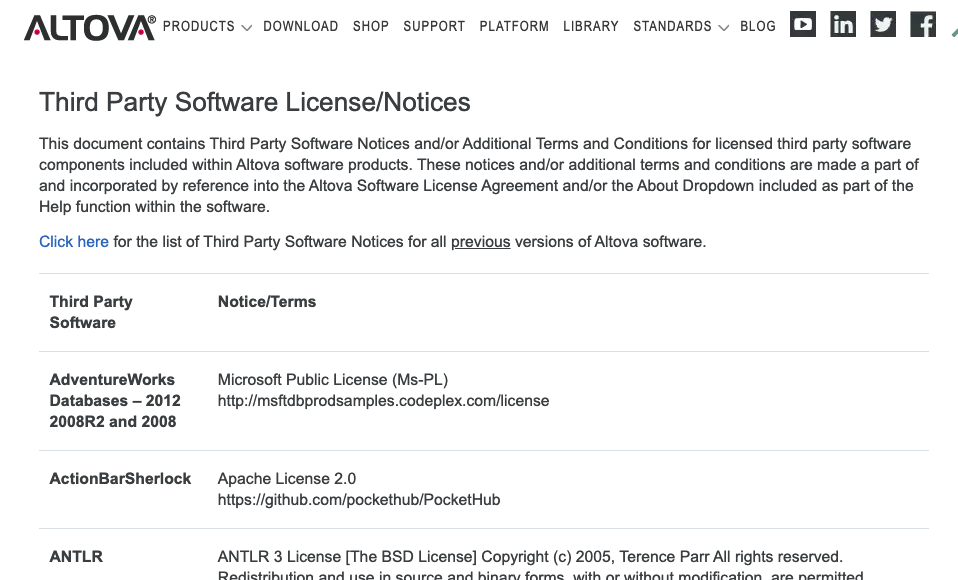
SBOM is an acronym that means Software Bill Of Materials. The concept originates from the manufacturing industry, where a bill of materials lists dependent components in machinery. A SBOM lists all third-party components present in your application. A good SBOM also lists the licences used by each component and, when possible, the specific copyright attribution. An excellent SBOM can also provide further information, such as possible relationships between those components to better understand any supply chain risk. You may have encountered SBOMs in the past, known as “third party notice” documents created to manage legal requirements, such as the one in the image below.
However, modern SBOMs are “machine-readable”. They follow a strict specification that can be understood by a computer.
What machine-readable formats are used to publish SBOMs?
The most commonly used formats to define a SBOM are:
CycloneDX, a lightweight open-source standard designed for use in application security context and supply chain component analysis. This originated from within the OWASP community.
SPDX, an open source format with origins in the Linux Foundation, slightly more complex, and recently approved as ISO/IEC standard in version 2.2.1 as ISO IEC 5962:2021.
SWID, another ISO/IEC industry standard used by various commercial software publishers.
All these formats support a variety of use cases, but the first two (CycloneDX and SPDX) are the most versatile. Due to SPDX’s complexity, we think CycloneDX has an edge at this time, but only time can tell which of these formats will be the winner. To learn more about these formats you can also read the official NTIA publication, which drills down into the matter.
Why are SBOMs important? And how are they useful?
As a consumer of software, the main reason why you want to have access to the SBOMs of the systems you are using is to manage risks. When a very commonly used software component becomes vulnerable: how do you know what you need to patch and which subsystems are at risk? This is exactly what happened with the recent Log4Shell debacle. The logging library called Log4j, was suddenly exploitable with a very simple and repeatable attack. How do you know where it is? Which one of the systems you are using is suddenly at risk? With a correctly managed archive of SBOMs, getting this information reduces to a very simple lookup task. Without it, it can be a real nuisance —a time consuming information hunt that disrupts everyone’s work flow.
As a producer of software, instead, you want to preserve and maintain an archive of all the SBOMs of the system you produce so that you can create and distribute timely patches to your customers. Having a systematic and comprehensive analysis of your most commonly used software packages would be useful indeed. Some companies were very fast in releasing patches to their customers, while others were extremely slow, mostly because they did not have the information. You probably want to be in the first group of companies 🙂
Governments are also mandating the need for use of SBOMs, realising that software security needs to be regulated. The U.S. Executive Order 14028 that mandates all federal agencies to require SBOMs from their suppliers. This not only impacts the companies that have direct sales to the US government but also their own software suppliers. As so many systems and devices have been connecting to the Internet to send and receive information, consequently our digital world relies on a software supply chain. This “ripple effect” will be significant for many industries.
Very carefully :), because an SBOM contains the full list of the “ingredients” of your system or application. While open-source projects happily share this information to the world, the same does not apply to private companies. In fact, a malicious actor that gets hold of the SBOM of your system can then check if you are using any vulnerable components. There are public vulnerability databases, such as the NVD, which are very popular. Someone can simply browse in there and compose a list of possible attacks, try them, and maybe get lucky. Probably 9 out of 10 vulnerabilities affecting components in your system won’t be exploitable, but having the ability to go through the whole list, certainly makes the task of finding an exploit much easier.
There’s no need to keep SBOMs a complete secret, however, as long as a few simple principles are kept in check:
SBOMs need to be shared securely,
they need to be accessed only by the authorised parties, across organisational boundaries, and
they should not be tampered with.
In summary, it is essential to produce a precise SBOM, and it is just as vital to share it and maintain it securely with the correct (trusted) third parties.
Why bother with SBOMs now?
In summary, it is essential to produce a precise SBOM, and it is just as vital to share it and maintain it securely with the correct (trusted) third parties. In our hyper connected world, comprehensive coverage of components is important for preventative strategies and threat detection in supply chain attacks. Therefore, implementing SBOM management proactively now will be worth something to your organisation when the next critical vulnerability appears and stand your organisation in good stead. All good collections are worth organising. How valuable is your collection of software?
The need for SBOMs is already high. Level up your open source software security and implement this requirement. Check out the SBOM capabilities in Meterian-X platform’s approach to DevSecOps.