The automotive giant’s recent cyber breach shows why continuous vulnerability assessment and open-source security are no longer optional.
Earlier this month, Jaguar Land Rover (JLR), the UK’s largest carmaker, was forced to shut down global IT systems after a cyberattack disrupted production across its factories. Plants in Solihull, Halewood, Wolverhampton, and Slovakia were halted. Operations in China, India, and Brazil also felt the ripple effect.
Thousands of employees and suppliers were sent home. Dealers and garages had to switch to manual operations during one of the busiest sales periods of the year: the September license plate registration window.
While no customer data breach has been confirmed, the attack reflects how deeply cybersecurity failures in the supply chain can damage both business operations and national economies. JLR contributes nearly 4% of the UK’s exports.
How the Jaguar Land Rover Attack Happened
The hacking coalition calling itself “Scattered Lapsus$ Hunters” claimed responsibility, posting internal screenshots as proof. Analysts link the group to earlier social engineering campaigns carried out by collectives like Scattered Spider, Lapsus$, and ShinyHunters.
This was not a sophisticated zero-day exploit. It was an attack on trust and resilience. By exploiting weaknesses in IT systems and operational processes, attackers triggered a shutdown that cascaded across JLR’s entire global network.
For an industry where every production hour counts, this was a direct hit to the supply chain.
Why Supply Chain Vulnerabilities Are a Critical Business Risk
The JLR case illustrates the stark reality:
Operational Technology (OT) systems are connected to IT systems. A breach in one disrupts the other.
Third-party risk is first-party risk. If suppliers or partners are compromised, your own resilience is at stake.
Downtime is as damaging as data loss. Even without stolen records, JLR faces millions in lost productivity and missed sales.
Open-source software is everywhere. Modern automotive systems depend on open-source libraries and components. Without continuous monitoring, hidden risks can remain undetected until it’s too late.
Where Vulnerability Assessment Makes the Difference
SBOM (Software Bill of Materials) to ensure visibility into every open-source component used in critical systems
Continuous monitoring for newly disclosed CVEs that could disrupt supply chains
DevSecOps integration to ensure remediation is part of the development and deployment pipeline
Incident readiness through real-time alerts and automated remediation guidance
How Meterian Helps Build Resilience
Meterian’s platform is built to detect, monitor, and remediate open-source vulnerabilities before they cause widespread damage.
BOSS (Business Open Source Sentinel): Provides real-time alerts for newly disclosed vulnerabilities across your software supply chain.
Sentinel: Automates vulnerability assessment and integrates into your CI/CD workflows to block unsafe code before it reaches production.
SBOM generation and ingestion: Gives you complete visibility into the components your business depends on, simplifying compliance and response.
AI-powered continuous monitoring: Ensures you are always ahead of emerging threats—whether in PHP, Java, .NET, or any other stack critical to your business.
Had such systems been in place across JLR and its suppliers, the blast radius of this attack could have been contained, with faster detection and remediation.
Why Open-Source Security Matters
The JLR breach demonstrates a truth we see across industries: open-source security is business security.
When 80–90% of modern applications depend on open-source components, every unpatched library becomes a potential entry point. The cost of ignoring these risks isn’t theoretical. It’s operational paralysis, financial loss, and reputational damage.
Don’t Wait for the Next Breach
The JLR cyber attack is not an isolated incident. It is part of a wider trend of supply chain attacks targeting global industries. The question is not whether open-source vulnerabilities exist in your systems—they do.
The question is: are you continuously monitoring and remediating them?
Now is the time to take control of your software supply chain.
👉 Learn how to strengthen resilience in our upcoming webinar: “What’s Open Source Security Got to Do with Resilience of the Supply Chain?” 📅 September 18, 2025 • 14:00 BST • 15:00 CET • 09:00 ET • 18:30 IST
Essential Steps for Leaders Before the Next Supply Chain Attack
Author: Rod Cobain • 4 min read
A Storm Is Brewing
We live in an age of unprecedented digital dependency. From agile startups to global enterprises, modern organizations rely on interconnected software systems, primarily driven by open source software (OSS). While OSS is powerful, flexible, and cost-effective, it increasingly represents a critical cybersecurity risk.
Cyber attackers are aggressively exploiting open source vulnerabilities, targeting the tools and libraries that power global innovation. The question isn’t whether your organization uses open source software—it undoubtedly does. The critical question is: How effectively are you securing it?
This article will explore:
Why open source vulnerabilities attract cyber attacks.
The evolving nature of these threats.
The crucial role of cybersecurity thought leadership.
Strategic actions leaders must take immediately.
Open Source Software: The Expanding Attack Surface
The Prevalence of Open Source
80-90% of modern applications incorporate OSS components.
OSS underpins critical infrastructure including finance, AI, and cloud services.
OSS adoption is accelerating within IoT and edge computing environments.
Why Attackers Target Open Source
A single vulnerability can impact thousands or millions of systems.
Attackers view the software supply chain as an attractive, often poorly defended target.
Many organizations lack visibility into OSS dependencies.
Recent High-Profile Incidents
Log4Shell (Log4j): A critical vulnerability in a widely used Java library triggered global disruption.
Allocate resources to enhance OSS security measures.
Support cross-industry initiatives and SBOM adoption.
Promote a culture where software security is central to business strategy.
The Broader Impact: Securing a Global Commons
Open source software represents a global digital commons. Poor security practices risk widespread systemic failure, not just isolated breaches. Robust thought leadership from security and business executives can act as a force multiplier by:
Without proactive leadership, organizations face continuous cycles of reactive firefighting. With it, we can build resilience and trust in the digital future.
Conclusion: Your Leadership Legacy
The stakes have never been higher:
Attackers are innovating rapidly.
OSS vulnerabilities will continue to surface and be exploited.
Regulatory landscapes and liability expectations are evolving quickly.
Now is the time for bold cybersecurity leadership that transcends organizational silos, engages across industries, and shapes global security practices. As a leader, ask yourself:
Is your organization prepared for the next OSS attack?
Are you shaping the conversation or merely reacting?
What legacy will you leave in securing the software that powers the world?
The future of digital trust depends on your answers.
Part 1: What Business Leaders Must Learn from Recent Cyber Vulnerabilities
Author: Rod Cobain • 4 min read
AI-generated image of business professionals
Open source software powers your business, it’s a fact whether you know it or not. From core infrastructure to everyday applications, open source code is embedded deep within the tools we trust. It’s a quiet enabler of innovation, agility, and scale.
But recent high-profile vulnerabilities, from Log4Shell to the XZ Utils backdoor, have exposed a hard truth; what’s free and open can also be fragile and risky. For business leaders, these incidents aren’t just technical hiccups. They’re a boardroom-level ticking time bomb. It’s time we stop treating open source security as an engineering detail and start addressing it as a strategic priority.
Many assume that popular open source projects are secure because they’re widely used. But visibility isn’t the same as scrutiny. The Log4Shell vulnerability sat undetected in a core Java logging library for nearly a decade until Dec 2021. When discovered, it impacted millions of computers, everything from cloud platforms to consumer apps. As a business leader, if your business relies on open source (and it does), you must invest in ongoing due diligence, not blind trust. Recent supply chain issues should prompt critical questions such as, “What’s in my software supply chain?” and “How’s it monitored?”.
Your Risk is Reflected by Your Dependencies
A single compromised component can ripple across countless systems. Looking at the event-streamincident, a small JavaScript library was hijacked and weaponised to steal cryptocurrency. As a business leader, demanding visibility into your organisation’s dependency map is a must, ignorance is no excuse, and cyber insurance providers are not covering such risks. Are you relying on unknown or unmaintained components in your software development production? If the answer is “yes or not sure”, you need to have your code assets scanned, and either automatically remediated or managed with a mitigation plan. As a result of the widespread consequences these open source vulnerabilities can have, since the Log4Shell incident, insurance providers require customers to prove they’ve patched or risk losing their insurance cover benefits.
Underfunded Projects Power Billion-Pound Businesses
The most alarming aspect of many open source vulnerabilities isn’t the flaw itself, but the lack of maintenance. The XZ backdoor came about partly because the project had only one active maintainer, such is the nature of open source community driven software. Therefore consumers and enterprises using the open source library inherit the responsibility for the quality and security of the instance used in its own coding projects. Adopting a pro-active 24/7 solution that incorporates continuous monitoring, automated remediation, and AI-powered vulnerability detection, is essential for identifying and addressing issues swiftly.
Leadership takeaway: Small investment vs Large payout or loss of credibility is clear.
Speed of Response Is a Competitive Advantage
Putting in place a pro-active approach when vulnerabilities emerge–detect, prioritise, and patch quickly– can prevent disruption and protect your reputation. Marks & Spencer, Co-op and others are still striving to regain normality in the weeks to come. These unfortunate incidents of “world class companies” highlight how security response has become a key measure of business agility. Are your teams empowered with the tools and authority to act swiftly when open source risks emerge?
The Future of Open Source Security
Open source is here to stay. Its growth is undeniable and remains a cornerstone of technological innovation for good. But security can’t just be an engineering checkbox. It must be part of your organisation’s culture, led from the top. Encourage a mindset of proactive security and open collaboration. The best organisations view open source software not just as free software, but as shared infrastructure worth protecting.
Conclusion
Cyber vulnerabilities in open source is not a reason to fear the model. Instead, they’re a call to engage more responsibly with it. As leaders, we must stop viewing open source security as someone else’s problem. The reality is: if your business runs on open source, its security must be your priority. Your role may not be a technical one, but asking the right questions and knowing your options from the beginning will help you take a preventive stance to ensure you don’t end up as tomorrow’s headline.
Today’s Reality Check: Vulnerability Management is Non-Negotiable
With the MITRE CVE system being the backbone of global vulnerability identification, it’s alarming to see discussions about funding cuts that could jeopardize this critical resource. If the industry loses its shared language for describing digital flaws, we’re all in trouble. This could stifle innovation in vulnerability management and mitigation, leaving organizations scrambling for reliable data in the U.S. and globally.
The industry needs to rally. We must collaborate on alternative funding models, invest in open-source initiatives, and forge partnerships that keep vital resources like CVE alive and thriving. Let’s ensure that our defenses remain robust, even in the face of disruption.
Meterian: The Power Database and Invisible Security Platform You Need
While others may falter, Meterian is charging ahead. Our vulnerability database is not just comprehensive; it’s a powerhouse, tracking over 400,000+ vulnerabilities and receiving daily automatic updates from a multitude of sources. We pull data from the National Vulnerability Database, GitHub Security Advisories, and 15 other unique feeds. But we don’t stop there. Our AI-generated insights, combined with meticulous manual curation, deliver a done-for-you service that your security and engineering teams can depend on.
In short, we provide your enterprise with a pair of automated eagle eyes, ensuring you have full visibility into potential software weaknesses in your third-party software supply chain.
Quality and Volume
Our commitment to excellence means you get the best tools to manage vulnerabilities effectively, for your team’s tech stack and workflow. We have a multitude of integrations and our OpenAPI architecture means we can collaborate to create more value together.
Join the Revolution
It’s time to elevate your cybersecurity strategy with the best solution for your team. Ready to take your cybersecurity to the next level? Check out our product page infographic to see how our database stacks up against the competition.
Recent high profile cyber security incidents have reinforced the importance of cleaning up the open-source software supply chain. From Heartbleed to the Apache Software Foundation’s Log4j vulnerability, these highly publicised incidents have exposed the threats associated with the software supply chain.
Open source security vulnerabilities are nothing new. Heartbleed was a security bug in the OpenSSL cryptography library that affected many systems. Similarly, Log4Shell is a severe vulnerability, however in the case of Log4j the number of affected systems could well run into potentially billions. Many cybersecurity experts have characterised Log4Shell as the single biggest, most critical vulnerability of the last decade.
These incidents have brought into sharp focus the risks and galvanised a range of responses at national and international level. It even prompted the White House to convene an Open Source Software Security Summit in January that was attended by leaders from global technology companies including Google, Meta, Apple, and Cisco. Members of the open source community were also represented at the summit, as well as US government agencies, including the Cybersecurity and Infrastructure Security Agency, the National Security Council and the National Institute of Standards and Technology.
The gathering may have been precipitated by the Log4Shell vulnerability, but the wider context was clear. How do we ensure source code, build, and distribution integrity to achieve effective open source security management?
Open source under the microscope
Technology companies have been using open source for years as it speeds up innovation and time to market. Indeed, most major software developments include open source software – including software used by the national security community.
Open source software brings unique value, but it also has unique security challenges. It is used extensively, however, the responsibility of ongoing security maintenance is carried out by a community of dedicated volunteers. These security incidents have demonstrated that the use of open source is so ubiquitous that no company can blindly continue in the mode of business as usual. Recent research showed that 73% of applications scanned have at least one vulnerability[1]. These can be buried deep in the open source software supply chain that software-driven businesses rely on for basic functionality and security to accelerate their time to market.
The known unknown
The concept of known knowns, known unknowns and unknown unknowns has been widely used as a risk assessment methodology. When it comes to cybersecurity and the voracity of threat actors to exploit vulnerabilities, it is a useful analogy.
Let’s take Apache Log4J as an example. Companies often create products by assembling open source and commercial software components. Almost all software will have some form of ability to journal activity and Log4j is a very common component used for this.
How do you quickly patch what you don’t know you have?
Java logger Log4j 2 – A zero-day vulnerability
Log4J was originally released in 2001, and over the last 20 years it has been used in billions of software developments and applications across the world. For logging incidents within software, Log4j is used by everything from the humble 404 error message, gaming software such as Minecraft, and Cloud providers such as iCloud and Amazon Web Services, as well as for all manner of software and security tools.2 On 9 December 2021, the zero-day vulnerability in the Java logger Log4j 2, known as Log4Shell, sent shockwaves across organisations as security teams scrambled to patch the flaw. If left unfixed, attackers can break into systems, steal passwords and logins, extract data, and infect networks with malicious software causing untold damage, not least to brand reputations.
However, herein lies the problem. How do you quickly patch what you don’t know you have?
Often in the race to innovate, the first thing sacrificed is up-to-date documentation. Without it how does a company know if Log4J is integrated within its application estate, let alone know if it has been previously patched.
Improving safety and trust when speed is of the essence
If we are to increase safety and trust in software, we must improve transparency and visibility across the entire software supply chain. Companies should have the ability to automatically identify open source components in order to monitor and manage security risk from publicly disclosed vulnerabilities. A software bill of materials (SBOM) should be a minimum for any project or development. Without such visibility of all component parts, security teams cannot manage risk and will be unaware, and potentially exposed, to dangers lurking in their software.
Case study – Full Visibility within an Hour
To give an example; one of the largest UK based financial services company with millions of customers across the world discovered it had Log4J embedded within dozens of in-house developed software projects. Having seen the first reports of the vulnerability at the start of the business day, within an hour the security team had identified projects using Log4j and were able to start work on follow up activities. By the end of the day, the entire business had a concise list of projects at risk, some of which were already remediated.
How was this achieved?
The company had automated tooling integrated into their software development environment with comprehensive component security. This enabled them to quickly identify those software projects which depended on the affected log4j component.
This visibility allowed the company to devise remediation plans to mitigate the risks of the vulnerability in Log4J. The company was able to target valuable resources across multiple locations to ensure fixes were applied quickly to critical business applications within just a couple of hours. While they were implementing an action plan based on the organisation’s use of Log4j, some of its competitors without such comprehensive tools were still in the information gathering stage.
Innovating securely
As organisations continue to innovate at pace in order to reduce time to market, the reliance on open source software continues to increase. However, when the security of a widely-used open source component or application is compromised, every company, every country, and every community is impacted.
The White House has taken an important first step in trying to identify the challenges present in the open source software supply chain and encourage the sharing of ideas on ways to mitigate risk and enhance resilience. Organisations can and should take advantage of the many benefits that open source software can deliver, but they must not do it blindly. Ensuring you know the exact make-up of your technology stack including all the component parts is an important first step. Choosing discovery tools that have the widest comprehensive coverage is important, and so too is the flexibility to grade alerts so that only the most pressing threats are highlighted. This avoids ‘alert fatigue’ and enables security teams to focus resource where it matters most, putting organisations in a good position to act fast when vulnerabilities are discovered.
Hackers faced with stronger security defences will continue to turn their attention to the weaker underbelly of the software supply chain. Now is the time for organisations to implement integrated and automated tooling to gain comprehensive risk control of components in their open-source software supply chain. Only by increasing visibility, coverage of known unknowns and transparency can companies stay one step ahead.
1 Meterian research from aggregated and anonymised data of 2044 scanned software applications in 2020.
We are sure many of you have been hearing about SBOMs. Nowadays, software include some components with code written by your own developers, but 80-90% of the code is typically from third-party developers. How can you know who produced what and when it absolutely needs to be replaced? Since Meterian has been managing SBOMs for awhile, we’re happy to share our know-how so you can consider a comprehensive strategy to manage your open source software supply chain.
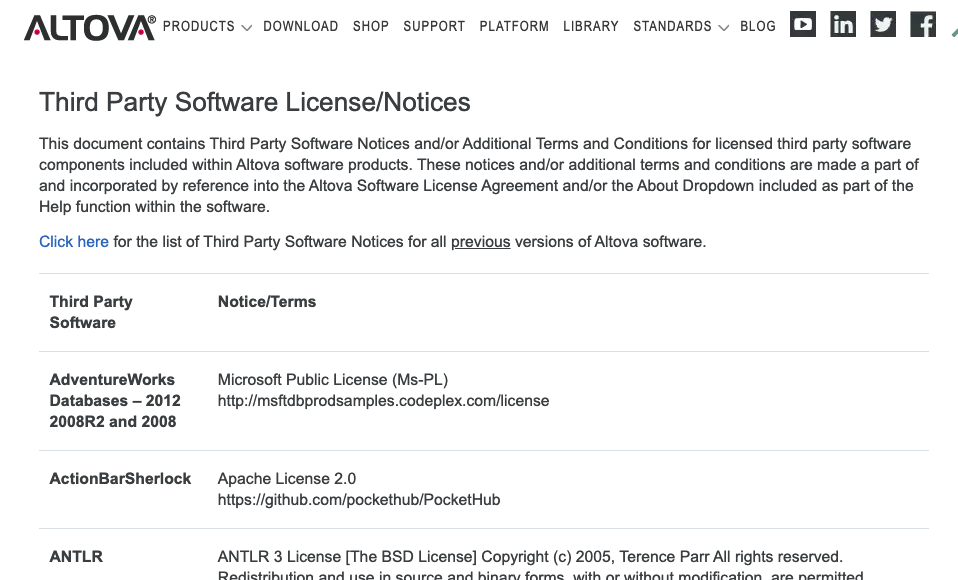
SBOM is an acronym that means Software Bill Of Materials. The concept originates from the manufacturing industry, where a bill of materials lists dependent components in machinery. A SBOM lists all third-party components present in your application. A good SBOM also lists the licences used by each component and, when possible, the specific copyright attribution. An excellent SBOM can also provide further information, such as possible relationships between those components to better understand any supply chain risk. You may have encountered SBOMs in the past, known as “third party notice” documents created to manage legal requirements, such as the one in the image below.
However, modern SBOMs are “machine-readable”. They follow a strict specification that can be understood by a computer.
What machine-readable formats are used to publish SBOMs?
The most commonly used formats to define a SBOM are:
CycloneDX, a lightweight open-source standard designed for use in application security context and supply chain component analysis. This originated from within the OWASP community.
SPDX, an open source format with origins in the Linux Foundation, slightly more complex, and recently approved as ISO/IEC standard in version 2.2.1 as ISO IEC 5962:2021.
SWID, another ISO/IEC industry standard used by various commercial software publishers.
All these formats support a variety of use cases, but the first two (CycloneDX and SPDX) are the most versatile. Due to SPDX’s complexity, we think CycloneDX has an edge at this time, but only time can tell which of these formats will be the winner. To learn more about these formats you can also read the official NTIA publication, which drills down into the matter.
Why are SBOMs important? And how are they useful?
As a consumer of software, the main reason why you want to have access to the SBOMs of the systems you are using is to manage risks. When a very commonly used software component becomes vulnerable: how do you know what you need to patch and which subsystems are at risk? This is exactly what happened with the recent Log4Shell debacle. The logging library called Log4j, was suddenly exploitable with a very simple and repeatable attack. How do you know where it is? Which one of the systems you are using is suddenly at risk? With a correctly managed archive of SBOMs, getting this information reduces to a very simple lookup task. Without it, it can be a real nuisance —a time consuming information hunt that disrupts everyone’s work flow.
As a producer of software, instead, you want to preserve and maintain an archive of all the SBOMs of the system you produce so that you can create and distribute timely patches to your customers. Having a systematic and comprehensive analysis of your most commonly used software packages would be useful indeed. Some companies were very fast in releasing patches to their customers, while others were extremely slow, mostly because they did not have the information. You probably want to be in the first group of companies 🙂
Governments are also mandating the need for use of SBOMs, realising that software security needs to be regulated. The U.S. Executive Order 14028 that mandates all federal agencies to require SBOMs from their suppliers. This not only impacts the companies that have direct sales to the US government but also their own software suppliers. As so many systems and devices have been connecting to the Internet to send and receive information, consequently our digital world relies on a software supply chain. This “ripple effect” will be significant for many industries.
Very carefully :), because an SBOM contains the full list of the “ingredients” of your system or application. While open-source projects happily share this information to the world, the same does not apply to private companies. In fact, a malicious actor that gets hold of the SBOM of your system can then check if you are using any vulnerable components. There are public vulnerability databases, such as the NVD, which are very popular. Someone can simply browse in there and compose a list of possible attacks, try them, and maybe get lucky. Probably 9 out of 10 vulnerabilities affecting components in your system won’t be exploitable, but having the ability to go through the whole list, certainly makes the task of finding an exploit much easier.
There’s no need to keep SBOMs a complete secret, however, as long as a few simple principles are kept in check:
SBOMs need to be shared securely,
they need to be accessed only by the authorised parties, across organisational boundaries, and
they should not be tampered with.
In summary, it is essential to produce a precise SBOM, and it is just as vital to share it and maintain it securely with the correct (trusted) third parties.
Why bother with SBOMs now?
In summary, it is essential to produce a precise SBOM, and it is just as vital to share it and maintain it securely with the correct (trusted) third parties. In our hyper connected world, comprehensive coverage of components is important for preventative strategies and threat detection in supply chain attacks. Therefore, implementing SBOM management proactively now will be worth something to your organisation when the next critical vulnerability appears and stand your organisation in good stead. All good collections are worth organising. How valuable is your collection of software?
The need for SBOMs is already high. Level up your open source software security and implement this requirement. Check out the SBOM capabilities in Meterian-X platform’s approach to DevSecOps.
The topic of sustainability is unmissable at the moment. As the urgency of the situation grows, it continues to demand attention from various sectors and industries within society. You may wonder where the cyber security industry fits into all of this. Whilst traditionally from very different worlds, they are united through the characteristics of constant innovation and the capacity to bring about real change for the better. Certainly, cyber security has a bigger role to play in the overarching battle for a more sustainable world than one may initially think.
The Industry
As around two thirds of greenhouse gas emissions world wide are associated with burning fossil fuels1, renewable energy is a good place to start. The UK currently has the largest number of offshore wind resources in the world, equating to about 10GW in operation outside of the border2. Infrastructure such as this pushes us one step closer to meeting the UK’s target of reaching net zero emissions by 20502. It’s not just the UK that has set the ball rolling in the fight against greenhouse emissions, our friends across the pond are aiming for no electricity sector carbon emissions by 2035— as outlined by Biden3. So, whilst this growing industry means great things for our hopes of preserving the world we live in, mass investment means it is also shaping up to be a very lucrative market for cyber criminals to direct their efforts towards. Jim Guinn, global managing director for cyber security in energy, chemicals, utilities and mining at Accenture states, “The cybersecurity conversation in the renewable energy engineering and construction business is almost nonexistent today.”3 It is imperative that an industry gaining traction as quickly as this one protects itself with the necessary defense measures against cyber attacks.
How exactly are renewable energy plants made vulnerable to cyber hackers?
As mentioned before, sustainability shares close ties with new innovation. Renewables depend on control systems and distribution networks supported by technology. As many sources of renewable energy, such as wind and solar power are not readily available 24/7 like fossil fuels are— they require storage previsions that are also underpinned by technology4. IoT plays a huge role in the remote monitoring, control and regulation of off-shore wind turbines5. As we know, more than 75% of the code in use that makes these technologies a reality is open source, putting open source components smack bang in the middle of the sustainability conversation. However, older wind farms and their communication systems were never designed with the “security by design” mindset like the IEC 62443 standard6, similar to the GDPR principle7. As stated by Jim Guinn “renewables have lax cybersecurity standards, as they are an industry that may be more focused on building first and leaving cybersecurity as an afterthought”3.
Past attacks
A first example in which renewable energy facilities became victims of cyber attacks was the 2014 DragonFly hack8. The cyber criminal group used Remote Access Trojans (RAT) named Backdoor.Oldrea and Trojan.Karagany to infiltrate energy grid operators, major electricity generation firms, petroleum pipeline operators, and Energy industry industrial control system (ICS) equipment manufacturers located in the United States, Spain, France, Italy, Germany, Turkey, and Poland. The hackers had been present in systems since 2011 before detection. Although reports indicate that the overarching aim of the hack was to gather intelligence, later investigation suggested it also had the capacity to take control of physical systems themselves.
A second example in which renewable energy facilities have fallen victim to cyber attack was the SPower hack of 2019. Unfortunately, the group gained the title of being the first U.S. provider of solar and wind renewable energy to have been the victim of a cyber-attack. A hacker used a vulnerability in a Cisco firewall to interrupt the connection between sPower’s wind and solar power generation installations and the company’s main command center9.
More recently, Colonial Pipeline’s hack10– reported on 7th May 2021 fell victim to a cyber attack, highlighting just how seriously energy supplies can be affected by cyber criminal organisations. As a result of ransomware, one of the U.S’ biggest pipelines was forced to shut down operations11. In the subsequently released statement it was revealed that after a 90M bitcoin payout, Colonial Pipeline said that remediation is ongoing and each system is being worked on in an “incremental approach”12. This attack compromised around 45% of the East Coast’s fuel, including gasoline, diesel, home heating oil, jet fuel, and military supplies. Whilst the energy jeopardised in this case was not renewable, Jonathan White, director of NREL’s cybersecurity program office highlighted that “As the penetration of renewable generation and EV charging stations increases in the future, the consequence of a successful attack is likely to be similar in aggregate to those of a successful attack to a natural gas, coal or nuclear plant today”3. Thus, a cyber attack such as the one launched on Colonial Pipeline gives a worrying insight into the potential damage that could be launched on the renewable energy sector.
Risks for the future
After using the Meterian web scanner to evaluate the security of some major UK energy suppliers, we were able to see that similar issues are being faced. For example, the UK’s biggest supplier of energy, British Gas received a security score of 0 out of a best possible 100. Our report indicates that they currently have components in use that pose a threat to their system, as well as components in use with undeclared licenses.
Again, after scanning https://firstlightfusion.com/, one of the UK’s leading renewable energy suppliers, we found 2 high threat level vulnerabilities and 3 medium threat level vulnerabilities, as well as components in use with undeclared licenses.
As this sector grows in both relevance and monetary value, there is a need for adequate cyber security that is growing in unison. According to industry growth trajectories, the renewable energy sector is set to become a big target of cyber hackers. As shown in this blog, experts have not been afraid to warn that more needs to be done to reinforce the security of renewable plants. The need is made even more important to protect consumers’ faith in new energy sources that play an important role in our fight against climate change.
There is some evidence that the tide is changing to benefit the cybersecurity of the energy sector, both traditional and renewable. On 12th May 2021 Biden issued The Executive Order on Improving the Nation’s Cybersecurity13. A few main points from the bill are:
New and more stringent cyber security standards for government purchased software including multi-factor authentication and endpoint detection and response of software.
Suppliers of technology must provide a SBOM (Software Bill Of Materials) that highlights the source of the software (supplier ID) that can be used to perform a risk assessment. This supplier ID can be used to alert high risk software if it is not verified by the digital signature applied to a SBOM14.
There is to be the enforced sharing of intel surrounding cyber attacks, in the hope that the sharing of information will benefit us all. Jennifer Bisceglie, President and CEO of enterprise resilience company Interos Inc., stated that “we live in a world that people are, and companies are very concerned about their brand and reputation”15 and thus are reluctant to admit to cyber breaches. The new bill is set to remove fear of blame and shame and promote collaborative learning and continuous improvement for a safer and stronger society in the digital world.
An automatic, continuous line of defence protecting the open source components in use in renewable energy control systems is one way that Meterian can support the ongoing battle against carbon emissions. Whilst incremental in their support of rapid innovation, open source components are a pressure point to security systems of which cyber attackers are not afraid to make use of.
Visit our homepage to learn more about how Meterian can secure your businesses’ open source components—keeping cyber hackers out and your intellectual property in.
1 “Energy and climate change”. European Environment Agency, 11 May 2021, https ://www.eea.europa.eu/signals/signals-2017/articles/energy-and-climate-change
2GOV.UK, 6 October 2020, https ://www.gov.uk/government/news/new-plans-to-make-uk-world-leader-in-green-energy
3 Vasquez, Christian. “CYBERSECUIRTY: Biden is eyeing renewable energy. So are hackers”. E&E News, 22 December 2020, https ://www.eenews.net/stories/1063721291
4 Ruhle, Micheal and Trakimavicius, Lukas. “Cyberattacks are the new challenge for renewable energy”. Politico, 18 July 2017, https ://www.politico.eu/article/opinion-cyberattacks-are-the-new-challenge-for-renewable-energy/
5 Taylor-Smith, Kerry. “How IoT can improve the performance of offshore windfarms”. NS Energy, 15 May 2020, https ://www.nsenergybusiness.com/features/iot-wind-power/
6 Freudenberg, Wolf K. “Why windfarms need to step up cyber security”. DNV, https ://www.dnv.com/article/why-windfarms-need-to-step-up-cyber-security-128082.
9 Cimpanu, Catalin. “Cyber-attack hits Utah wind and solar energy provider”. ZDNet, 31 October 2019, https ://www.zdnet.com/article/cyber-attack-hits-utah-wind-and-solar-energy-provider/
10 “Colonial Pipeline confirms it paid $4.4m ransom to hacker gang after attack”. The Guardian, 20 May 2021, https ://www.theguardian.com/technology/2021/may/19/colonial-pipeline-cyber-attack-ransom
11 Galiordi, Natalie. “Colonial Pipeline aims to restore operations by end of the week after cyberattack”. ZDNet, 10 May 2021, https ://www.zdnet.com/article/colonial-pipeline-aims-to-restore-operations-by-end-of-the-week-after-cyberattack/
12 Stevens, Pippa. “Owner of pipeline shuttered by cyber attack aims to restore service by end of the week”. CNBC, 10 May 2021, https ://www.cnbc.com/2021/05/10/colonial-says-parts-of-fuel-pipeline-being-brought-online-aims-to-restore-service-by-end-of-week.html
13The White House, 12 May 2021, https ://www.whitehouse.gov/briefing-room/presidential-actions/2021/05/12/executive-order-on-improving-the-nations-cybersecurity/
14 Brooks, Richard. energycentral, 21 May 2021, https ://energycentral.com/c/ec/cybersecurity-executive-order-requires-new-software-security-standards-synopsys
15 Roby, Karen. MSN, “Expert: Biden’s executive order on cyber security is a good start toward protecting organizations”. 26 May 2021, https ://www.msn.com/en-us/money/smallbusiness/expert-bidens-executive-order-on-cybersecurity-is-a-good-start-toward-protecting-organizations/ar-AAKnd7E?ocid=uxbndlbing